
Join Our JEE Preparation Group
Prep with like-minded aspirants; Get access to free daily tests and study material.
Sign in
Please select an account to continue using cracku.in
↓ →
Join Our JEE Preparation Group
Prep with like-minded aspirants; Get access to free daily tests and study material.
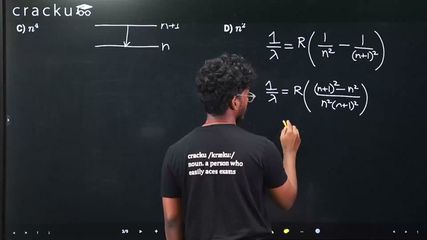
The electron of a hydrogen atom makes a transition from the $$(n+1)^{\text{th}}$$ orbit to the $$n^{\text{th}}$$ orbit. For large $$n$$ the wavelength of the emitted radiation is proportional to
For a hydrogen atom the energy of the electron in the $$n^{\text{th}}$$ Bohr orbit is given by
$$E_n = -\frac{13.6\ \text{eV}}{n^2}$$
The photon emitted when the electron drops from orbit $$n+1$$ to orbit $$n$$ carries an energy equal to the difference between these two levels:
$$\Delta E = \lvert E_{n+1} - E_n \rvert$$
Substituting the Bohr energies,
$$\Delta E = \left| -\frac{13.6}{(n+1)^2} - \left(-\frac{13.6}{n^2}\right) \right| = 13.6 \left[ \frac{1}{n^2} - \frac{1}{(n+1)^2} \right]$$
Simplify the bracket:
$$\frac{1}{n^2} - \frac{1}{(n+1)^2} = \frac{(n+1)^2 - n^2}{n^2(n+1)^2} = \frac{n^2 + 2n + 1 - n^2}{n^2(n+1)^2} = \frac{2n + 1}{n^2(n+1)^2}$$
Hence
$$\Delta E = 13.6 \frac{2n + 1}{n^2(n+1)^2}$$
For large $$n$$ we can drop the +1 terms inside brackets: $$2n+1 \approx 2n$$ and $$(n+1)^2 \approx n^2$$. Therefore
$$\Delta E \approx 13.6 \frac{2n}{n^4} = \frac{27.2}{n^3}$$
The emitted photon's wavelength $$\lambda$$ is related to its energy by $$\Delta E = \frac{hc}{\lambda}$$, so
$$\lambda = \frac{hc}{\Delta E} \propto \frac{1}{\Delta E} \propto n^3$$
Thus, for large $$n$$ the wavelength varies directly as $$n^3$$.
Option B which is: $$n^3$$
Was this solution helpful?
Click on the Email ☝️ to Watch the Video Solution
Create a FREE account and get:
_1.webp)

Educational materials for JEE preparation

Ask our AI anything

AI can make mistakes. Please verify important information.
AI can make mistakes. Please verify important information.


