
Join Our JEE Preparation Group
Prep with like-minded aspirants; Get access to free daily tests and study material.
Sign in
Please select an account to continue using cracku.in
↓ →
Join Our JEE Preparation Group
Prep with like-minded aspirants; Get access to free daily tests and study material.
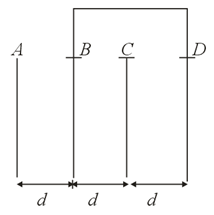
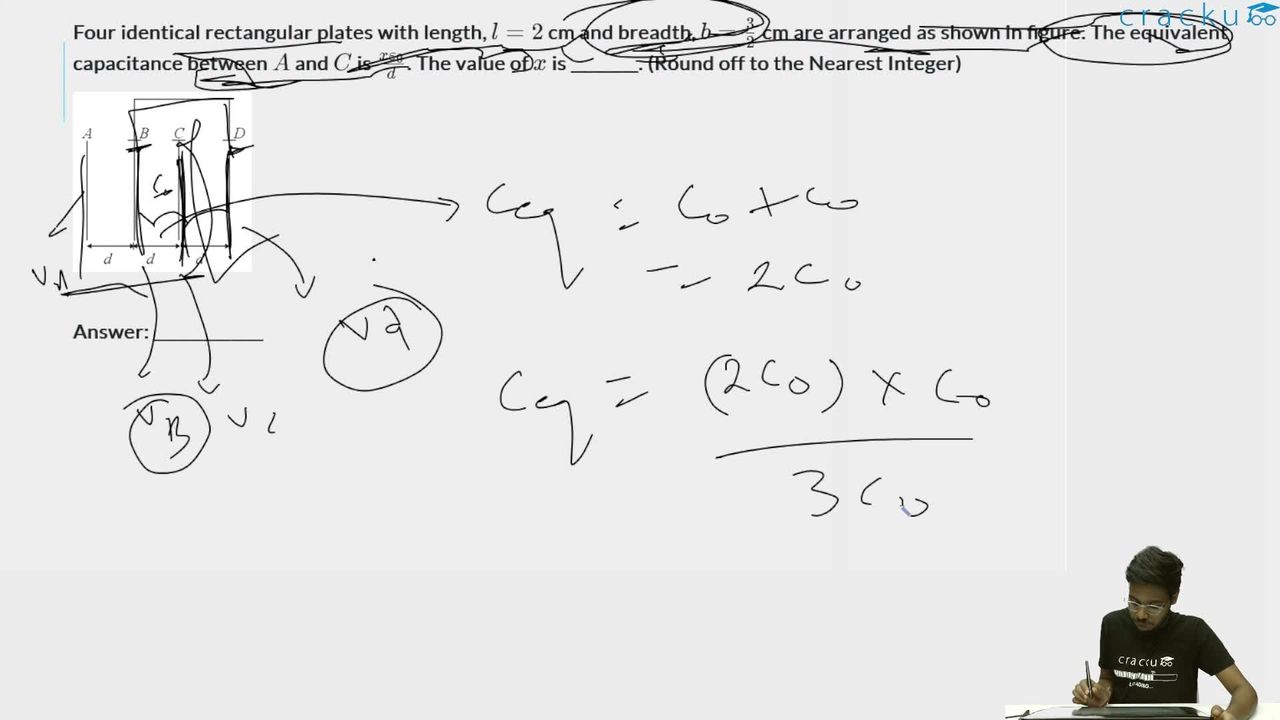
Four identical rectangular plates with length, $$l = 2$$ cm and breadth, $$b = \frac{3}{2}$$ cm are arranged as shown in figure. The equivalent capacitance between $$A$$ and $$C$$ is $$\frac{x\varepsilon_0}{d}$$. The value of $$x$$ is ________. (Round off to the Nearest Integer)
Correct Answer: 2
We need to find the equivalent capacitance between terminals $$A$$ and $$C$$ for the given system of four identical rectangular plates.
From the layout shown on the page, the system consists of four parallel plates ($$A$$, $$B$$, $$C$$, and $$D$$) separated by a uniform distance $$d$$. Notice the wire connection: plate $$B$$ is connected directly to plate $$D$$ by a conducting wire.
The area ($$Area$$) of each rectangular plate is calculated from its length ($$l$$) and breadth ($$b$$):
The capacitance ($$C_0$$) between any two adjacent parallel surfaces is:
$$C_0 = \frac{\varepsilon_0 \cdot Area}{d} = \frac{3 \cdot \varepsilon_0}{d}$$
The four consecutive plates form three separate parallel-plate capacitor regions in the gaps between them:
Since plates $$B$$ and $$D$$ are joined by a wire, they share the same electrical potential (they form a single common node). Consequently:
This means Capacitor 2 and Capacitor 3 are connected in parallel with each other across the nodes $$C$$ and $$B$$. Their combined capacitance is:
$$C_{23} = C_0 + C_0 = 2C_0$$
Now, this parallel combination
Was this solution helpful?
Click on the Email ☝️ to Watch the Video Solution
Create a FREE account and get:
_1.webp)

Educational materials for JEE preparation

Ask our AI anything

AI can make mistakes. Please verify important information.
AI can make mistakes. Please verify important information.
