
Join Our JEE Preparation Group
Prep with like-minded aspirants; Get access to free daily tests and study material.
Sign in
Please select an account to continue using cracku.in
↓ →
Join Our JEE Preparation Group
Prep with like-minded aspirants; Get access to free daily tests and study material.
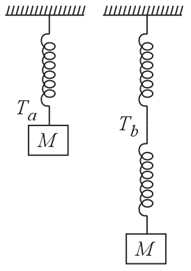
Consider two identical springs each of spring constant $$k$$ and negligible mass compared to the mass $$M$$ as shown. Fig. 1 shows one of them and Fig. 2 shows their series combination. The ratios of time period of oscillation of the two SHM is $$\frac{T_b}{T_a} = \sqrt{x}$$, where value of $$x$$ is ________. (Round off to the Nearest Integer)
Correct Answer: 2
We need to determine the value of $$x$$, which represents the ratio of the time periods of oscillation between a single spring system and a series combination of two identical springs.
The time period ($$T$$) of a simple harmonic motion (SHM) mass-spring system is given by the formula:
$$T = 2\pi \sqrt{\frac{M}{k_{\text{eq}}}}$$
Where $$M$$ is the attached mass and $$k_{\text{eq}}$$ is the equivalent spring constant of the configuration.
In Fig. 1, a single mass $$M$$ is attached to a single spring of spring constant $$k$$.
The time period $$T_a$$ is:
$$T_a = 2\pi \sqrt{\frac{M}{k}}$$
In Fig. 2, two identical springs, each of spring constant $$k$$, are connected end-to-end in a series combination.
The time period $$T_b$$ is:
$$T_b = 2\pi \sqrt{\frac{M}{\left(\frac{k}{2}\right)}} = 2\pi \sqrt{\frac{2M}{k}}$$
Now, we take the ratio of the two time periods:
$$x = \frac{T_b}{T_a} = \frac{2\pi \sqrt{\frac{2M}{k}}}{2\pi \sqrt{\frac{M}{k}}}$$
Canceling out the common terms ($$2\pi$$ and $$\sqrt{\frac{M}{k}}$$) simplifies the expression to:
$$x =2
Was this solution helpful?
Click on the Email ☝️ to Watch the Video Solution
Create a FREE account and get:
_1.webp)

Educational materials for JEE preparation

Ask our AI anything

AI can make mistakes. Please verify important information.
AI can make mistakes. Please verify important information.
