
Join Our JEE Preparation Group
Prep with like-minded aspirants; Get access to free daily tests and study material.
Sign in
Please select an account to continue using cracku.in
↓ →
Join Our JEE Preparation Group
Prep with like-minded aspirants; Get access to free daily tests and study material.
A parallel plate capacitor whose capacitance $$C$$ is 14 pF is charged by a battery to a potential difference $$V = 12$$ V between its plates. The charging battery is now disconnected and a porcelain plate with $$k = 7$$ is inserted between the plates, then the plate would oscillate back and forth between the plates with a constant mechanical energy of ________ pJ. (Assume no friction)
Correct Answer: 864
We have a parallel plate capacitor with capacitance $$C = 14$$ pF charged to a potential difference $$V = 12$$ V. After the battery is disconnected, a porcelain plate with dielectric constant $$k = 7$$ is inserted between the plates. We need to find the constant mechanical energy with which the dielectric plate oscillates.
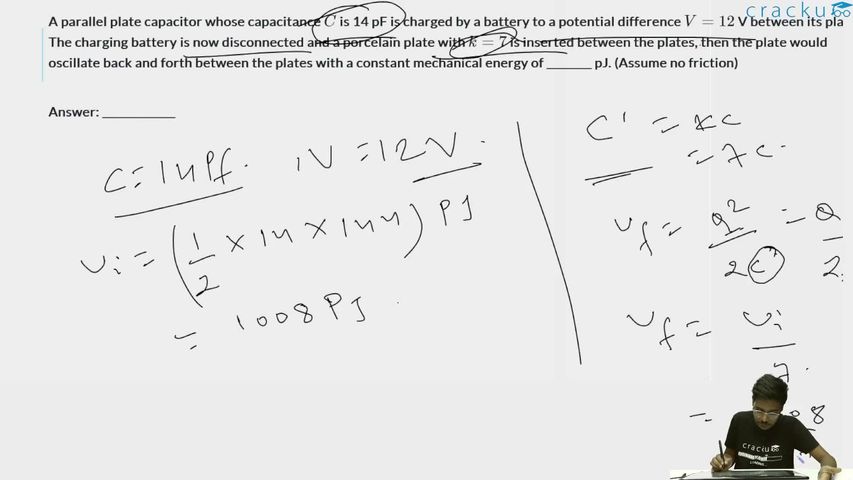
The initial energy stored in the capacitor (before inserting the dielectric) is $$U_i = \frac{1}{2}CV^2 = \frac{1}{2} \times 14 \times 12^2 = \frac{1}{2} \times 14 \times 144 = 1008$$ pJ.
Since the battery is disconnected, the charge on the capacitor remains constant: $$Q = CV = 14 \times 12 = 168$$ pC. After the dielectric is fully inserted, the new capacitance becomes $$C' = kC = 7 \times 14 = 98$$ pF.
The final energy stored with the dielectric fully inside is $$U_f = \frac{Q^2}{2C'} = \frac{Q^2}{2kC} = \frac{U_i}{k} = \frac{1008}{7} = 144$$ pJ.
By conservation of energy, the decrease in electrical energy converts to mechanical energy (kinetic energy of the oscillating plate). The mechanical energy is $$E = U_i - U_f = 1008 - 144 = 864$$ pJ.
Since there is no friction, this mechanical energy remains constant throughout the oscillation, and the dielectric plate oscillates back and forth with a constant mechanical energy of $$\boxed{864}$$ pJ.
Was this solution helpful?
Click on the Email ☝️ to Watch the Video Solution
Create a FREE account and get:
_1.webp)

Educational materials for JEE preparation

Ask our AI anything

AI can make mistakes. Please verify important information.
AI can make mistakes. Please verify important information.
