
Join Our JEE Preparation Group
Prep with like-minded aspirants; Get access to free daily tests and study material.
Sign in
Please select an account to continue using cracku.in
↓ →
Join Our JEE Preparation Group
Prep with like-minded aspirants; Get access to free daily tests and study material.
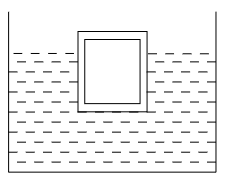
A cubical box made of a sheet of thickness 1 cm has external dimensions of 5 cm. When it floats in water it has three fourth of its external volume submerged in water. Find the density of the material of the cube. Due to a small hole in the bottom water flows in to the hollow space and the cube starts sinking. To what level would water rise when the cube is about to submerge.
Correct Answer: 0.957
The box displaces $$\frac{3}{4} \times 5^3 = 93.75\ \text{cm}^3$$ of water, so its mass is $$93.75\ \text{g}$$. The cavity is $$3\ \text{cm}$$ a side, so the material volume is $$125 - 27 = 98\ \text{cm}^3$$ and the density is $$\frac{93.75}{98} \approx 0.957\ \text{g/cm}^3$$. To be just about to submerge, the box would need $$125 - 93.75 = 31.25\ \text{g}$$ of water inside, i.e. a level of $$\frac{31.25}{9} \approx 3.47\ \text{cm}$$ in the $$3 \times 3\ \text{cm}^2$$ cavity. But the cavity is only $$3\ \text{cm}$$ high (holding $$27\ \text{g}$$), so with the data given the cavity fills completely and the box, now of mass $$120.75\ \text{g}$$, still floats with $$\frac{120.75}{25} \approx 4.83\ \text{cm}$$ of its 5 cm height submerged; it never sinks because its material is less dense than water.
Was this solution helpful?


Predict your JEE Main percentile, rank & performance in seconds

Educational materials for JEE preparation

Ask our AI anything

AI can make mistakes. Please verify important information.
AI can make mistakes. Please verify important information.