
Join Our JEE Preparation Group
Prep with like-minded aspirants; Get access to free daily tests and study material.
Sign in
Please select an account to continue using cracku.in
↓ →
Join Our JEE Preparation Group
Prep with like-minded aspirants; Get access to free daily tests and study material.
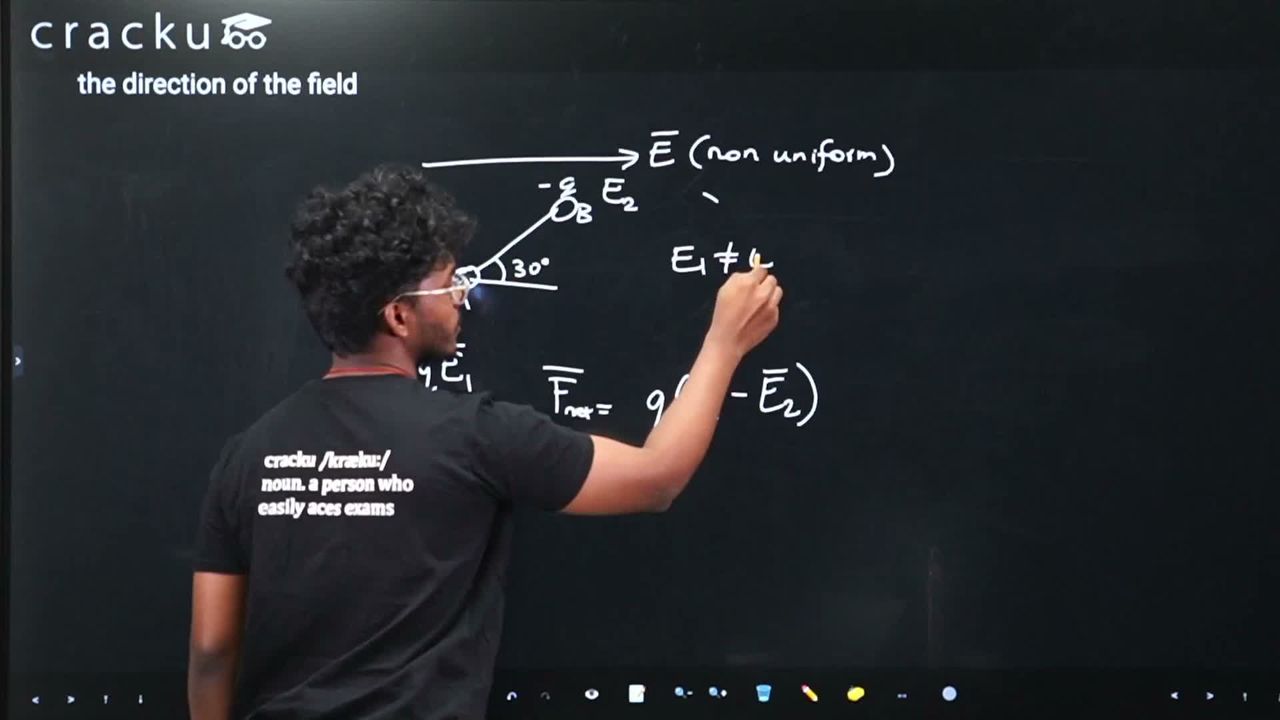
A electric dipole is placed at an angle of $$30^\circ$$ to a non-uniform electric field. The dipole will experience
When an electric dipole is placed in a non-uniform electric field, the electric field strength varies from point to point. Consequently, the two charges of the dipole experience different magnitudes of electric force.
Let the dipole consist of charges $$+q$$ and $$-q$$.
Let the electric field at the position of $$+q$$ be $$\vec{E}_1$$ and at the position of $$-q$$ be $$\vec{E}_2$$.
Because the field is non-uniform, $$\vec{E}_1 \neq \vec{E}_2$$.
The force on the positive charge is $$\vec{F}_1 = q\vec{E}_1$$.
The force on the negative charge is $$\vec{F}_2 = -q\vec{E}_2$$.
The net force acting on the dipole is the vector sum of these forces:
$$\vec{F}_{\text{net}} = \vec{F}_1 + \vec{F}_2 = q\vec{E}_1 - q\vec{E}_2 = q(\vec{E}_1 - \vec{E}_2)$$
Since $$\vec{E}_1 \neq \vec{E}_2$$, it follows that $$\vec{F}_{\text{net}} \neq 0$$. Thus, the dipole will experience a {net translational force}.
Additionally, the dipole is placed at an angle of $$30^\circ$$ with respect to the electric field. Because this angle is neither $$0^\circ$$ nor $$180^\circ$$, the lines of action of the forces $$\vec{F}_1$$ and $$\vec{F}_2$$ do not coincide.
These non-collinear forces produce a turning effect. Therefore, the dipole will also experience a net torque ($$\vec{\tau}_{\text{net}} \neq 0$$).
The dipole will experience both a net force and a net torque (option D)
Was this solution helpful?
Click on the Email ☝️ to Watch the Video Solution
Create a FREE account and get:
_1.webp)

Educational materials for JEE preparation

Ask our AI anything

AI can make mistakes. Please verify important information.
AI can make mistakes. Please verify important information.
