
Join Our JEE Preparation Group
Prep with like-minded aspirants; Get access to free daily tests and study material.
Sign in
Please select an account to continue using cracku.in
↓ →
Join Our JEE Preparation Group
Prep with like-minded aspirants; Get access to free daily tests and study material.
A beam of light consisting of red, green and blue colours is incident on a right-angled prism on face $$AB$$. The refractive indices of the material for the above red, green and blue colours are 1.39, 1.44 and 1.47 respectively.
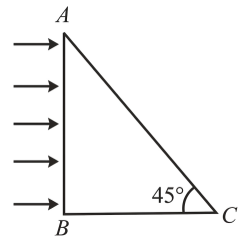
A person looking on surface $$AC$$ of the prism will see
The prism is a right-angled isosceles prism with $$\angle A = 90^{\circ},\; \angle B = \angle C = 45^{\circ}$$. The two perpendicular faces are $$AB$$ and $$AC$$, while $$BC$$ is the hypotenuse.
The mixed beam is incident normally on face $$AB$$, so it enters the prism without refraction and travels in a straight line. Because $$AB \perp AC$$, the ray that has just entered meets the face $$AC$$ making an angle of $$45^{\circ}$$ with the normal to $$AC$$ (the angle between the two face normals equals the angle between the faces, i.e. $$90^{\circ}$$, hence each ray makes $$45^{\circ}$$ with each normal).
Whether the ray escapes or suffers total internal reflection (TIR) at $$AC$$ depends on how this $$45^{\circ}$$ compares with the critical angle $$\theta_c$$ for each colour.
The critical angle is given by
$$\sin\theta_c = \dfrac{n_{\text{air}}}{n_{\text{prism}}} = \dfrac{1}{\mu}$$
Calculate $$\theta_c$$ for the three colours:
Red: $$\mu_r = 1.39 \;\;\Rightarrow\;\; \theta_{c,r} = \sin^{-1}\!\left(\dfrac{1}{1.39}\right) \approx 46^{\circ}$$
Green: $$\mu_g = 1.44 \;\;\Rightarrow\;\; \theta_{c,g} = \sin^{-1}\!\left(\dfrac{1}{1.44}\right) \approx 44^{\circ}$$
Blue: $$\mu_b = 1.47 \;\;\Rightarrow\;\; \theta_{c,b} = \sin^{-1}\!\left(\dfrac{1}{1.47}\right) \approx 43^{\circ}$$
Compare the actual angle of incidence ($$45^{\circ}$$) with each critical angle:
• For red: $$45^{\circ} \lt 46^{\circ} \;(\theta_{c,r})\;\Rightarrow$$ incidence is less than the critical angle ⇒ the red ray refracts out through $$AC$$ and can be seen.
• For green: $$45^{\circ} \gt 44^{\circ} \;(\theta_{c,g})\;\Rightarrow$$ incidence exceeds the critical angle ⇒ TIR occurs, so green does not emerge.
• For blue: $$45^{\circ} \gt 43^{\circ} \;(\theta_{c,b})\;\Rightarrow$$ incidence exceeds the critical angle ⇒ TIR occurs, so blue does not emerge.
Hence only the red component comes out of face $$AC$$. A person looking at that face will therefore see red light alone.
Option D which is: red colour only
Was this solution helpful?
Create a FREE account and get:
_1.webp)

Educational materials for JEE preparation

Ask our AI anything

AI can make mistakes. Please verify important information.
AI can make mistakes. Please verify important information.


