
Join Our JEE Preparation Group
Prep with like-minded aspirants; Get access to free daily tests and study material.
Sign in
Please select an account to continue using cracku.in
↓ →
Join Our JEE Preparation Group
Prep with like-minded aspirants; Get access to free daily tests and study material.
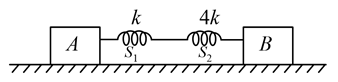
In the reported figure, two bodies A and B of masses 200 g and 800 g are attached with the system of springs. Springs are kept in a stretched position with some extension when the system is released. The horizontal surface is assumed to be frictionless. The angular frequency will be ___ rad s$$^{-1}$$ when $$k = 20$$ N m$$^{-1}$$.
Correct Answer: 10
We need to determine the angular frequency ($$\omega$$) of the two-body spring system when it is released from its stretched position on a frictionless horizontal surface.
From the problem , two springs ($$S_1$$ and $$S_2$$) are connected end-to-end between block $$A$$ and block $$B$$. This configuration constitutes a series combination.
We calculate the equivalent spring constant ($$k_{\text{eq}}$$) using the series formula:
$$\frac{1}{k_{\text{eq}}} = \frac{1}{k_1} + \frac{1}{k_2} = \frac{1}{k} + \frac{1}{4k}$$
$$\frac{1}{k_{\text{eq}}} = \frac{4 + 1}{4k} = \frac{5}{4k} \implies k_{\text{eq}} = \frac{4k}{5}$$
Given that $$k = 20\text{ N m}^{-1}$$, we find the numerical value of $$k_{\text{eq}}$$:
$$k_{\text{eq}} = \frac{4 \times 20}{5} = 16\text{ N m}^{-1}$$
Since both masses are free to move on the frictionless surface, the system acts as a two-body oscillator. The motion can be simplified by analyzing it using the concept of reduced mass ($$\mu$$):
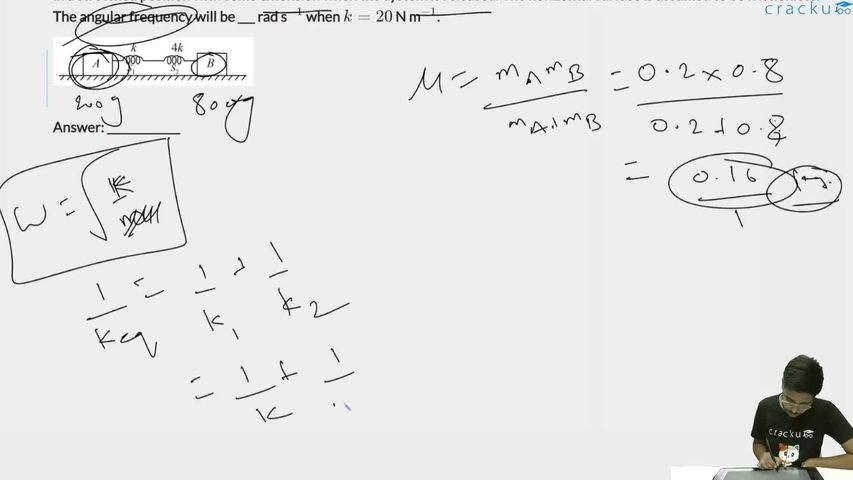
$$\mu = \frac{m_A \cdot m_B}{m_A + m_B} = \frac{0.2 \times 0.8}{0.2 + 0.8} = \frac{0.16}{1.0} = 0.16\text{ kg}$$
The formula for the angular frequency of a two-body spring system is given by:
$$\omega = \sqrt{\frac{k_{\text{eq}}}{\mu}}$$
Substitute our calculated values for $$k_{\text{eq}}$$ and $$\mu$$ into the equation:
$$\omega = \sqrt{\frac{16}{0.16}} = \sqrt{100} = 10\text{ rad s}^{-1}$$
The angular frequency of the system when released is 10 $$\text{rad s}^{-1}$$.
Was this solution helpful?
Click on the Email ☝️ to Watch the Video Solution
Create a FREE account and get:
_1.webp)

Educational materials for JEE preparation

Ask our AI anything

AI can make mistakes. Please verify important information.
AI can make mistakes. Please verify important information.
