
Join Our JEE Preparation Group
Prep with like-minded aspirants; Get access to free daily tests and study material.
Sign in
Please select an account to continue using cracku.in
↓ →
Join Our JEE Preparation Group
Prep with like-minded aspirants; Get access to free daily tests and study material.
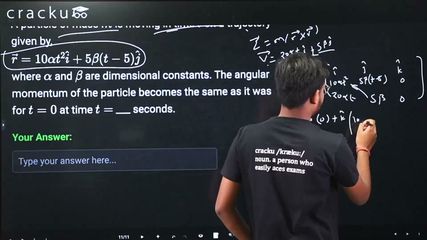
A particle of mass $$m$$ is moving in time $$t$$ on a trajectory given by,
$$\vec{r} = 10\alpha t^2 \hat{i} + 5\beta (t - 5)\hat{j}$$
where $$\alpha$$ and $$\beta$$ are dimensional constants. The angular momentum of the particle becomes the same as it was for $$t = 0$$ at time $$t =$$ ___ seconds.
Correct Answer: 10
We need to determine the time $$t > 0$$ at which the angular momentum of the particle equals its initial angular momentum at $$t = 0$$.
From the problem statement , the position vector $$\vec{r}(t)$$ of the particle of mass $$m$$ is given by:
$$\vec{r}(t) = 10\alpha t^2 \hat{i} + 5\beta(t - 5)\hat{j}$$
To find the velocity vector $$\vec{v}(t)$$, we take the first derivative of the position vector with respect to time ($$\vec{v} = \frac{d\vec{r}}{dt}$$):
$$\vec{v}(t) = \frac{d}{dt}\left(10\alpha t^2\right)\hat{i} + \frac{d}{dt}\left(5\beta t - 25\beta\right)\hat{j}$$
$$\vec{v}(t) = 20\alpha t \hat{i} + 5\beta \hat{j}$$
The angular momentum $$\vec{L}$$ of a particle about the origin is defined by the cross product of its position and linear momentum vectors:
$$\vec{L} = \vec{r} \times \vec{p} = m(\vec{r} \times \vec{v})$$
Let's calculate the cross product $$\vec{r} \times \vec{v}$$ explicitly using their unit vector components:
$$\vec{r} \times \vec{v} = \begin{vmatrix} \hat{i} & \hat{j} & \hat{k} \\ 10\alpha t^2 & 5\beta(t - 5) & 0 \\ 20\alpha t & 5\beta & 0 \end{vmatrix}$$
$$\vec{r} \times \vec{v} = \left[(10\alpha t^2)(5\beta) - (5\beta(t - 5))(20\alpha t)\right] \hat{k}$$
$$\vec{r} \times \vec{v} = \left[50\alpha\beta t^2 - 100\alpha\beta t(t - 5)\right] \hat{k}$$
$$\vec{r} \times \vec{v} = \left[50\alpha\beta t^2 - 100\alpha\beta t^2 + 500\alpha\beta t\right] \hat{k} = \left[500\alpha\beta t - 50\alpha\beta t^2\right] \hat{k}$$
Therefore, the angular momentum vector at any time $$t$$ is:
$$\vec{L}(t) = m\alpha\beta\left(500t - 50t^2\right)\hat{k}$$
First, evaluate the initial angular momentum at $$t = 0$$:
$$\vec{L}(0) = m\alpha\beta\left(500(0) - 50(0)^2\right)\hat{k} = \vec{0}$$
We are looking for a non-zero time $$t$$ where the angular momentum returns to this initial value ($$\vec{L}(t) = \vec{L}(0)$$):
$$m\alpha\beta\left(500t - 50t^2\right)\hat{k} = \vec{0}$$
Since the mass $$m$$ and dimensional constants $$\alpha, \beta$$ are non-zero, we can divide them out:
$$500t - 50t^2 = 0$$
$$50t(10 - t) = 0$$
This quadratic equation gives two solutions:
The angular momentum of the particle becomes the same as it was for $$t = 0$$ at time $$t =$$ 10 seconds.
Was this solution helpful?
Click on the Email ☝️ to Watch the Video Solution
Create a FREE account and get:
_1.webp)

Educational materials for JEE preparation

Ask our AI anything

AI can make mistakes. Please verify important information.
AI can make mistakes. Please verify important information.
