
Join Our JEE Preparation Group
Prep with like-minded aspirants; Get access to free daily tests and study material.
Sign in
Please select an account to continue using cracku.in
↓ →
Join Our JEE Preparation Group
Prep with like-minded aspirants; Get access to free daily tests and study material.
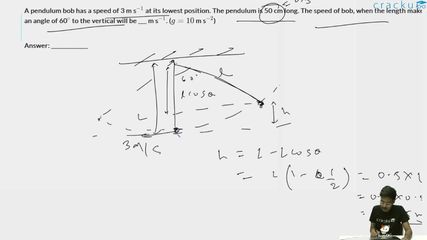
A pendulum bob has a speed of 3 m s$$^{-1}$$ at its lowest position. The pendulum is 50 cm long. The speed of bob, when the length makes an angle of 60$$^\circ$$ to the vertical will be ___ m s$$^{-1}$$. ($$g = 10$$ m s$$^{-2}$$)
Correct Answer: 2
Let the mass of the pendulum bob be $$m$$ and the length of the string be $$L = 0.50\ \text{m}$$. At its lowest position the bob has speed $$v_0 = 3\ \text{m s}^{-1}$$. We take the gravitational potential energy to be zero at this lowest point.
The principle we use is the conservation of mechanical energy, which states:
$$\text{Total mechanical energy at any position} = \text{constant.}$$
Hence,
$$\tfrac12 m v_0^{\,2} + 0 = \tfrac12 m v^{\,2} + m g h,$$
where
The height $$h$$ is obtained from simple geometry of the circle traced by the pendulum. When the string of length $$L$$ makes an angle $$\theta$$ with the vertical, the bob rises from the lowest point by
$$h = L - L\cos\theta = L(1 - \cos\theta).$$
Substituting $$L = 0.50\ \text{m}$$ and $$\theta = 60^\circ$$, and recalling that $$\cos 60^\circ = \tfrac12$$, we get
$$h = 0.50(1 - \tfrac12) = 0.50 \times 0.50 = 0.25\ \text{m}.$$
Now we substitute $$h$$ into the energy conservation equation:
$$\tfrac12 m (3)^{2} = \tfrac12 m v^{\,2} + m(10)(0.25).$$
Simplifying term by term, first compute the left side kinetic energy:
$$\tfrac12 m (3)^{2} = \tfrac12 m \times 9 = 4.5 m.$$
The potential energy term is
$$m g h = m \times 10 \times 0.25 = 2.5 m.$$
So the equation becomes
$$4.5 m = \tfrac12 m v^{\,2} + 2.5 m.$$
Subtract $$2.5 m$$ from both sides:
$$4.5 m - 2.5 m = \tfrac12 m v^{\,2}.$$
That gives
$$2.0 m = \tfrac12 m v^{\,2}.$$
Divide both sides by $$\tfrac12 m$$ (which is equivalent to multiplying by 2):
$$v^{\,2} = 4.$$
Finally, take the positive square root (speed is positive):
$$v = 2\ \text{m s}^{-1}.$$
So, the answer is $$2\ \text{m s}^{-1}$$.
Was this solution helpful?
Click on the Email ☝️ to Watch the Video Solution
Create a FREE account and get:
_1.webp)

Educational materials for JEE preparation

Ask our AI anything

AI can make mistakes. Please verify important information.
AI can make mistakes. Please verify important information.
