
Join Our JEE Preparation Group
Prep with like-minded aspirants; Get access to free daily tests and study material.
Sign in
Please select an account to continue using cracku.in
↓ →
Join Our JEE Preparation Group
Prep with like-minded aspirants; Get access to free daily tests and study material.
A whistle producing sound waves of frequencies $$9500\,Hz$$ and above is approaching a stationary person with speed $$v\,ms^{-1}$$. The velocity of sound in air is $$300\,ms^{-1}$$. If the person can hear frequencies upto a maximum of $$10{,}000\,Hz$$, the maximum value of $$v$$ upto which he can hear the whistle is
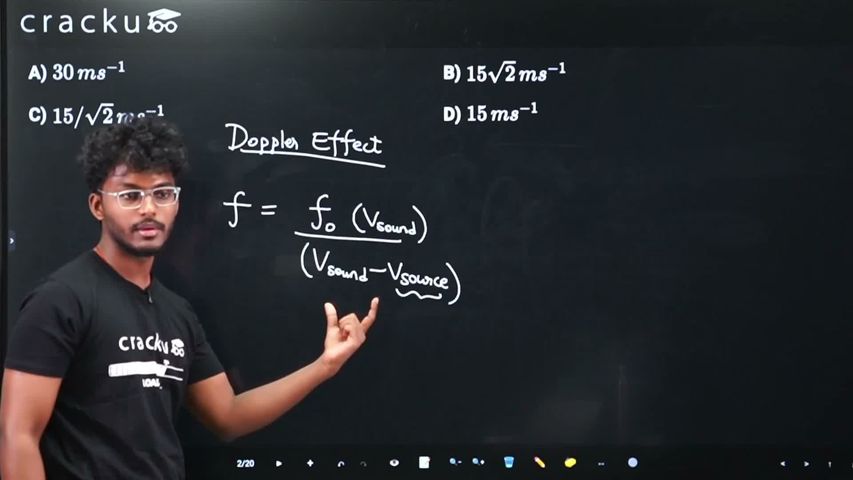
According to the Doppler effect, when a sound source approaches a stationary observer, the apparent frequency $$f'$$ heard by the observer is given by the formula:
$$f' = f \left( \frac{v_{\text{sound}}}{v_{\text{sound}} - v_{\text{source}}} \right)$$
Substitute the given values into the Doppler effect formula:
$$10000 = 9500 \left( \frac{300}{300 - v} \right)$$
$$20 = 19 \left( \frac{300}{300 - v} \right)$$
$$20(300 - v) = 19 \times 300$$
$$6000 - 20v = 5700$$
Rearrange the terms to solve for $$20v$$:
$$20v = 6000 - 5700$$
$$20v = 300$$
$$v = 15\text{ m/s}$$
The maximum value of $$v$$ up to which the person can hear the whistle is 15 m/s(option D)
Was this solution helpful?
Click on the Email ☝️ to Watch the Video Solution
Create a FREE account and get:
_1.webp)

Educational materials for JEE preparation

Ask our AI anything

AI can make mistakes. Please verify important information.
AI can make mistakes. Please verify important information.
