
Join Our JEE Preparation Group
Prep with like-minded aspirants; Get access to free daily tests and study material.
Sign in
Please select an account to continue using cracku.in
↓ →
Join Our JEE Preparation Group
Prep with like-minded aspirants; Get access to free daily tests and study material.
A small electric dipole $$\vec{p}_0$$, having a moment of inertia $$I$$ about its center, is kept at a distance $$r$$ from the center of a spherical shell of radius $$R$$. The surface charge density $$\sigma$$ is uniformly distributed on the spherical shell. The dipole is initially oriented at a small angle $$\theta$$ as shown in the figure. While staying at a distance $$r$$, the dipole is free to rotate about its center.
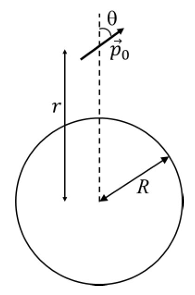
If released from rest, then which of the following statement(s) is (are) correct?
[$$\varepsilon_0$$ is the permittivity of free space.]
$$\tau=\vert{}\vec{p} \times \vec{E}\vert{}$$
$$I \alpha=p_0 E \sin \theta$$
$$\alpha=\frac{p \cdot \theta}{I}\left(\frac{1}{4 \pi \varepsilon_0} \frac{\sigma 4 \pi R^2}{r^2}\right)$$
$$\alpha=\left(\frac{p_0 \sigma R^2}{I \varepsilon_0 r^2}\right) \cdot \theta$$
$$\therefore \omega=\sqrt{\frac{p_0 \sigma R^2}{I \varepsilon_0 r^2}}$$
For $$r = 2R$$:
$$\omega=\sqrt{\frac{p_0 \sigma}{4 I \varepsilon_0}} \quad ( \mathrm{C \ is \ incorrect})$$
Also, for $$r=10 R$$:
$$\omega=\sqrt{\frac{p_0 \sigma}{I \varepsilon_0 (100)}} \quad ( \mathrm{D \ is \ correct})$$
It will oscillate for any finite value of $$r>R$$. (B is correct)
Was this solution helpful?
Create a FREE account and get:
_1.webp)

Educational materials for JEE preparation

Ask our AI anything

AI can make mistakes. Please verify important information.
AI can make mistakes. Please verify important information.
