
Join Our JEE Preparation Group
Prep with like-minded aspirants; Get access to free daily tests and study material.
Sign in
Please select an account to continue using cracku.in
↓ →
Join Our JEE Preparation Group
Prep with like-minded aspirants; Get access to free daily tests and study material.
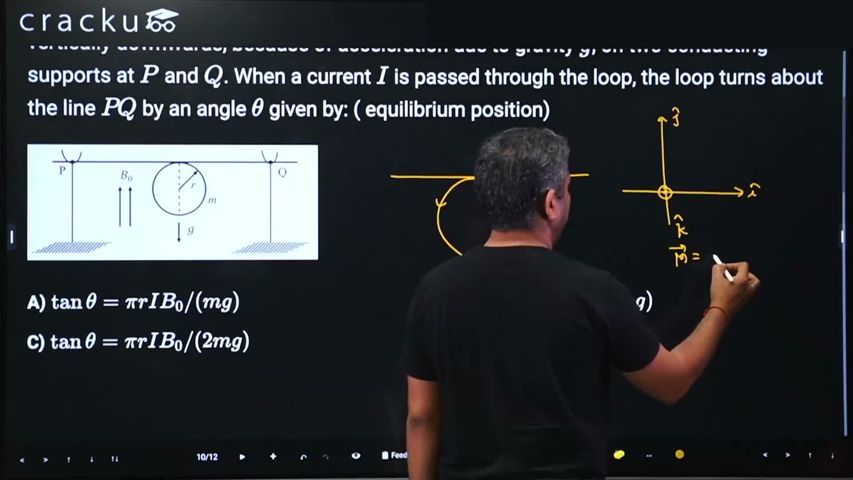
A thin stiff insulated metal wire is bent into a circular loop with its two ends extending tangentially from the same point of the loop. The wire loop has mass $$m$$ and radius $$r$$ and it is in a uniform vertical magnetic field $$B_0$$, as shown in the figure. Initially, it hangs vertically downwards, because of acceleration due to gravity $$g$$, on two conducting supports at $$P$$ and $$Q$$. When a current $$I$$ is passed through the loop, the loop turns about the line $$PQ$$ by an angle $$\theta$$ given by: ( equilibrium position)
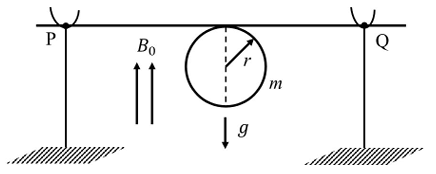
Using magnetic moment of a circular loop: $$M = I A = I(\pi r^2)$$
Using torque due to uniform vertical magnetic field $$B_0$$ when loop tilts by angle $$\theta$$:
$$\tau_m = \vert{}\vec{M} \times \vec{B}_0\vert{} = M B_0 \cos\theta = \pi r^2 I B_0 \cos\theta$$
Using restoring torque due to gravity acting at the center of mass:
$$\tau_g = m g (r \sin\theta) = m g r \sin\theta$$
Equating torques at rotational equilibrium about the axis $$PQ$$:
$$\tau_m = \tau_g \implies \pi r^2 I B_0 \cos\theta = m g r \sin\theta$$
$$\frac{\sin\theta}{\cos\theta} = \frac{\pi r^2 I B_0}{m g r} \implies \tan\theta = \frac{\pi r I B_0}{m g}$$
Was this solution helpful?
Click on the Email ☝️ to Watch the Video Solution
Create a FREE account and get:
_1.webp)

Educational materials for JEE preparation

Ask our AI anything

AI can make mistakes. Please verify important information.
AI can make mistakes. Please verify important information.
