
Join Our JEE Preparation Group
Prep with like-minded aspirants; Get access to free daily tests and study material.
Sign in
Please select an account to continue using cracku.in
↓ →
Join Our JEE Preparation Group
Prep with like-minded aspirants; Get access to free daily tests and study material.
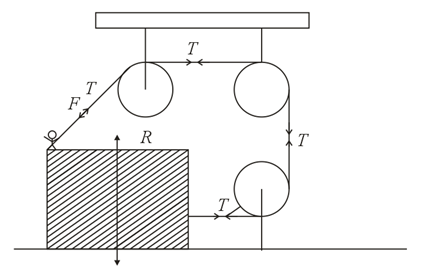
A boy of mass 4 kg is standing on a piece of wood having mass 5 kg. If the coefficient of friction between the wood and the floor is 0.5, the maximum force that the boy can exert on the rope so that the piece of wood does not move from its place is ________ N. (Round off to the Nearest Integer) [Take $$g = 10$$ m s$$^{-2}$$]
Correct Answer: 30
We need to determine the maximum force $$F$$ (tension $$T$$) that the boy can exert on the rope so that the piece of wood remains at rest on the floor.
Let the tension in the rope held by the boy be $$T$$. The forces acting vertically on the boy (mass $$m = 4\text{ kg}$$) are:
For vertical equilibrium of the boy:
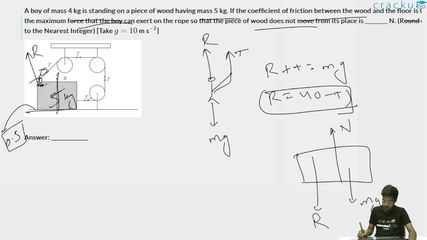
$$R + T = mg \implies R = 40 - T \quad \text{--- (Equation 1)}$$
Let's look at the forces acting on the piece of wood (mass $$M = 5\text{ kg}$$):
For vertical equilibrium of the wood:
$$N = Mg + R$$
Substitute $$R$$ from Equation 1 into this expression:
$$N = 50 + (40 - T) = 90 - T \quad \text{--- (Equation 2)}$$
$$f_s = \mu \cdot N$$
For the wood to stay in its place, the horizontal pulling force ($$T$$) must not exceed the maximum limiting friction ($$f_s$$):
$$T \le \mu \cdot N$$
Substitute the value of coefficient of friction ($$\mu = 0.5$$) and the normal force expression from Equation 2:
$$T = 0.5 \times (90 - T)$$
$$T = 45 - 0.5T$$
$$1.5T = 45$$
$$T = \frac{45}{1.5} = 30\text{ N}$$
The maximum force that the boy can exert on the rope so that the piece of wood does not move is 30 N.
Was this solution helpful?
Click on the Email ☝️ to Watch the Video Solution
Create a FREE account and get:
_1.webp)

Educational materials for JEE preparation

Ask our AI anything

AI can make mistakes. Please verify important information.
AI can make mistakes. Please verify important information.


