
Join Our JEE Preparation Group
Prep with like-minded aspirants; Get access to free daily tests and study material.
Sign in
Please select an account to continue using cracku.in
↓ →
Join Our JEE Preparation Group
Prep with like-minded aspirants; Get access to free daily tests and study material.
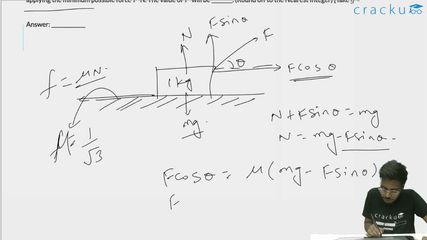
A body of mass 1 kg rests on a horizontal floor with which it has a coefficient of static friction $$\frac{1}{\sqrt{3}}$$. It is desired to make the body move by applying the minimum possible force $$F$$ N. The value of $$F$$ will be ________. (Round off to the Nearest Integer) [Take $$g = 10$$ m s$$^{-2}$$]
Correct Answer: 5
To move the body with the minimum possible force, the force $$F$$ should be applied at an angle $$\theta$$ above the horizontal. Resolving forces: the horizontal component $$F\cos\theta$$ must overcome friction, and the vertical component $$F\sin\theta$$ reduces the normal reaction.
The normal reaction is $$N = mg - F\sin\theta$$ and the friction force is $$f = \mu N = \mu(mg - F\sin\theta)$$. For the body to just move, $$F\cos\theta = \mu(mg - F\sin\theta)$$, giving $$F = \frac{\mu mg}{\cos\theta + \mu\sin\theta}$$.
To minimize $$F$$, we maximize the denominator $$\cos\theta + \mu\sin\theta$$. Taking the derivative and setting it to zero: $$-\sin\theta + \mu\cos\theta = 0$$, so $$\tan\theta = \mu = \frac{1}{\sqrt{3}}$$, which gives $$\theta = 30°$$.
The maximum value of the denominator is $$\cos 30° + \frac{1}{\sqrt{3}}\sin 30° = \frac{\sqrt{3}}{2} + \frac{1}{\sqrt{3}} \times \frac{1}{2} = \frac{\sqrt{3}}{2} + \frac{1}{2\sqrt{3}} = \frac{3 + 1}{2\sqrt{3}} = \frac{4}{2\sqrt{3}} = \frac{2}{\sqrt{3}}$$.
Therefore $$F = \frac{\frac{1}{\sqrt{3}} \times 1 \times 10}{\frac{2}{\sqrt{3}}} = \frac{10/\sqrt{3}}{2/\sqrt{3}} = \frac{10}{2} = 5$$ N.
Was this solution helpful?
Click on the Email ☝️ to Watch the Video Solution
Create a FREE account and get:
_1.webp)

Educational materials for JEE preparation

Ask our AI anything

AI can make mistakes. Please verify important information.
AI can make mistakes. Please verify important information.


