
Join Our JEE Preparation Group
Prep with like-minded aspirants; Get access to free daily tests and study material.
Sign in
Please select an account to continue using cracku.in
↓ →
Join Our JEE Preparation Group
Prep with like-minded aspirants; Get access to free daily tests and study material.
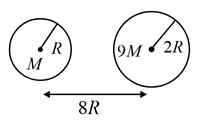
Suppose two planets (spherical in shape) of radii $$R$$ and $$2R$$, but mass $$M$$ and $$9M$$ respectively have a centre to centre separation $$8R$$ as shown in the figure. A satellite of mass $$m$$ is projected from the surface of the planet of mass $$M$$ directly towards the centre of the second planet. The minimum speed $$v$$ required for the satellite to reach the surface of the second planet is $$\sqrt{\frac{a}{7} \frac{GM}{R}}$$, then the value of $$a$$ is
[Given: The two planets are fixed in their position]
Correct Answer: 4
We need to determine the value of the parameter $$a$$ representing the minimum projection speed required for a satellite of mass $$m$$ to travel from the surface of the first planet to the surface of the second planet.
From the system geometry:
For the satellite to reach the second planet, it must be launched with enough kinetic energy to cross the neutral point ($$r_0$$) where the gravitational pull of both planets perfectly balances out. Let $$r_0$$ be the distance of this point from the center of the first planet:
$$\frac{G M m}{r_0^2} = \frac{G (9M) m}{(8R - r_0)^2}$$
Taking the square root of both sides:
$$\frac{1}{r_0} = \frac{3}{8R - r_0}$$
$$8R - r_0 = 3r_0 \implies 4r_0 = 8R \implies r_0 = 2R$$
Thus, the neutral point lies at a distance of $$2R$$ from the center of the first planet, and $$6R$$ from the center of the second planet.
We compare the mechanical energy of the satellite at its launch position (the surface of the first planet, at distance $$R$$ from its center) to its mechanical energy at the neutral point (at distance $$2R$$ from the first center), where its velocity momentarily drops to zero ($$v_f = 0$$):
Energy at the Launch Surface ($$E_i$$):
$$E_i = \frac{1}{2}mv^2 - \frac{GMm}{R} - \frac{G(9M)m}{7R}$$
Energy at the Neutral Point ($$E_f$$):
$$E_f = 0 - \frac{GMm}{2R} - \frac{G(9M)m}{6R} = -\frac{GMm}{2R} - \frac{3GMm}{2R} = -\frac{2GMm}{R}$$
Equating $$E_i = E_f$$ and canceling out the satellite mass $$m$$:
$$\frac{1}{2}v^2 - \frac{GM}{R} - \frac{9GM}{7R} = -\frac{2GM}{R}$$
$$\frac{1}{2}v^2 = \frac{GM}{R} + \frac{9GM}{7R} - \frac{2GM}{R}$$
$$\frac{1}{2}v^2 = \frac{9GM}{7R} - \frac{GM}{R}$$
$$\frac{1}{2}v^2 = \frac{2GM}{7R}$$
$$v^2 = \frac{4GM}{7R} \implies v = \sqrt{\frac{4GM}{7R}}$$
The problem states that the required minimum velocity is written in the form:
$$v = \sqrt{\frac{a}{7}\frac{GM}{R}}$$
Comparing our calculated result with this formula, we find:
$$a = 4$$
The value of $$a$$ required for the satellite to successfully reach the second planet's surface is 4.
Was this solution helpful?
Create a FREE account and get:
_1.webp)

Educational materials for JEE preparation

Ask our AI anything

AI can make mistakes. Please verify important information.
AI can make mistakes. Please verify important information.
