
Join Our JEE Preparation Group
Prep with like-minded aspirants; Get access to free daily tests and study material.
Sign in
Please select an account to continue using cracku.in
↓ →
Join Our JEE Preparation Group
Prep with like-minded aspirants; Get access to free daily tests and study material.
A stone of mass 20 g is projected from a rubber catapult of length 0.1 m and area of cross section $$10^{-6}$$ m$$^2$$ stretched by an amount 0.04 m. The velocity of the projected stone is _________ m s$$^{-1}$$. (Young's modulus of rubber = $$0.5 \times 10^9$$ N m$$^{-2}$$)
Correct Answer: 20
We are given a stone of mass $$m = 20\ \text{g}$$. First we convert this mass into SI units, because all our formulae use kilograms:
$$m = 20\ \text{g} = 20 \times 10^{-3}\ \text{kg} = 0.02\ \text{kg}.$$
The rubber catapult has an original (unstretched) length $$L = 0.1\ \text{m},$$ a cross-sectional area $$A = 10^{-6}\ \text{m}^2,$$ and it is stretched by an amount $$x = 0.04\ \text{m}.$$ We are also supplied the Young’s modulus of the rubber,
$$Y = 0.5 \times 10^{9}\ \text{N m}^{-2}.$$
Young’s modulus connects stress and strain through the relation
$$Y = \dfrac{\text{Stress}}{\text{Strain}} = \dfrac{F/A}{x/L},$$
where $$F$$ is the stretching force produced in the rubber. Rearranging, we obtain the magnitude of this force:
$$F = Y\,A\,\dfrac{x}{L}.$$
When the catapult is released, the elastic potential energy stored in the stretched rubber is converted into the kinetic energy of the stone. The elastic potential energy stored in a stretched rod is found by integrating the work done, or more directly by the spring-energy-like expression
$$U = \dfrac{1}{2} F x.$$
Substituting the expression for $$F$$ that we have just obtained, we write
$$U = \dfrac{1}{2} \left(Y A \dfrac{x}{L}\right) x = \dfrac{1}{2}\,Y\,A\,\dfrac{x^{2}}{L}.$$
Now we insert the numerical values step by step:
First evaluate the product in the numerator:
$$Y \, A = 0.5 \times 10^{9}\ \text{N m}^{-2} \times 10^{-6}\ \text{m}^{2} = 0.5 \times 10^{3}\ \text{N} = 500\ \text{N}.$$
However, since we will have an extra factor of $$\tfrac{1}{2}$$ outside, let us proceed carefully, keeping all factors explicit:
$$U = \dfrac{1}{2}\times (0.5 \times 10^{9}) \times (10^{-6}) \times \dfrac{(0.04)^2}{0.1}.$$
Multiply the first two numerical factors:
$$\dfrac{1}{2} \times 0.5 = 0.25,$$
and combine the powers of ten:
$$0.25 \times 10^{9} \times 10^{-6} = 0.25 \times 10^{3} = 250.$$
So the expression becomes
$$U = 250 \times \dfrac{(0.04)^2}{0.1}\ \text{J}.$$
Next square the extension:
$$(0.04)^2 = 0.0016.$$
Multiply this with 250:
$$250 \times 0.0016 = 0.4.$$
Finally divide by the original length $$L = 0.1\ \text{m}:$$
$$U = \dfrac{0.4}{0.1} = 4\ \text{J}.$$
This $$4\ \text{J}$$ of elastic potential energy becomes the kinetic energy of the stone. By the work-energy principle we therefore set
$$\dfrac{1}{2} m v^{2} = U.$$
Substituting $$m = 0.02\ \text{kg}$$ and $$U = 4\ \text{J}:$$
$$\dfrac{1}{2}\,(0.02)\,v^{2} = 4.$$
First multiply the left-hand constants:
$$\dfrac{1}{2}\times 0.02 = 0.01.$$
So we have
$$0.01\,v^{2} = 4,$$
which gives
$$v^{2} = \dfrac{4}{0.01} = 400.$$
Taking the positive square root (since speed is positive) we find
$$v = \sqrt{400} = 20\ \text{m s}^{-1}.$$
So, the answer is $$20$$.
Was this solution helpful?
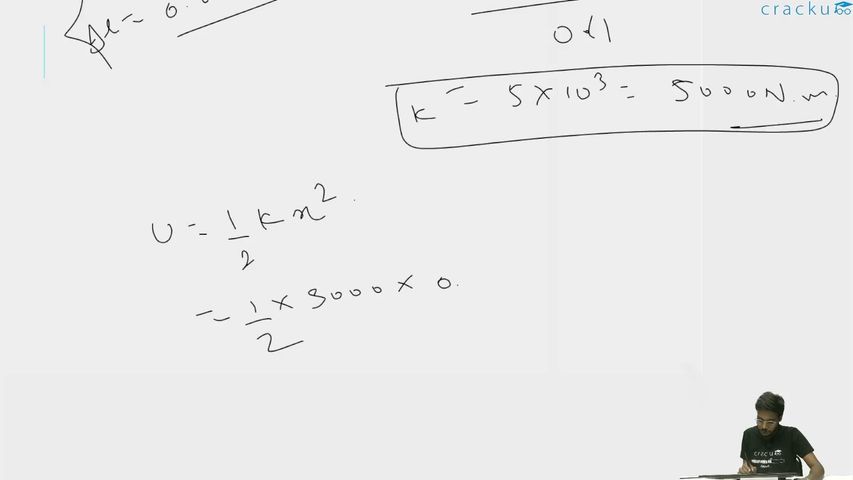
Click on the Email ☝️ to Watch the Video Solution
Create a FREE account and get:
_1.webp)

Educational materials for JEE preparation

Ask our AI anything

AI can make mistakes. Please verify important information.
AI can make mistakes. Please verify important information.
