
Join Our JEE Preparation Group
Prep with like-minded aspirants; Get access to free daily tests and study material.
Sign in
Please select an account to continue using cracku.in
↓ →
Join Our JEE Preparation Group
Prep with like-minded aspirants; Get access to free daily tests and study material.
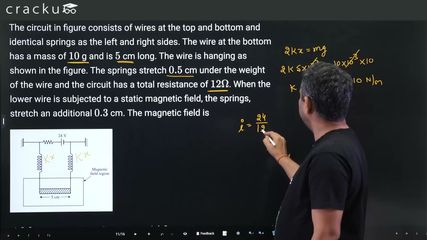
The circuit in figure consists of wires at the top and bottom and identical springs as the left and right sides. The wire at the bottom has a mass of $$10$$ g and is $$5$$ cm long. The wire is hanging as shown in the figure. The springs stretch $$0.5$$ cm under the weight of the wire and the circuit has a total resistance of $$12\Omega$$. When the lower wire is subjected to a static magnetic field, the springs, stretch an additional $$0.3$$ cm. The magnetic field is
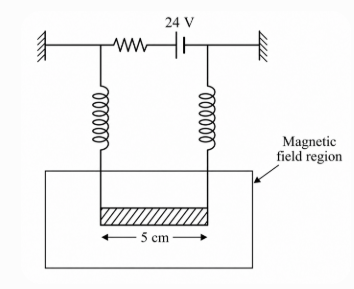
$$k_{\text{eq}} = 2k$$
Given: $$m = 10^{-2}\text{ kg}$$, $$x_1 = 5 \times 10^{-3}\text{ m}$$, $$x_2 = 3 \times 10^{-3}\text{ m}$$, $$V = 24\text{ V}$$, $$R = 12\ \Omega$$, $$l = 5 \times 10^{-2}\text{ m}$$
Using initial equilibrium:
$$mg = k_{\text{eq}}x_1 \implies 10^{-2} \times 10 = k_{\text{eq}} \times (5 \times 10^{-3}) \implies k_{\text{eq}} = 20\text{ N/m}$$
Using Ohm's law: $$I = \frac{V}{R} = \frac{24}{12} = 2\text{ A}$$
Using magnetic force for additional stretch: $$F_m = k_{\text{eq}}x_2 \implies I l B = k_{\text{eq}}x_2$$
$$2 \times (5 \times 10^{-2}) \times B = 20 \times (3 \times 10^{-3}) \implies 0.1B = 0.06 \implies B = 0.6\text{ T}$$
Using right-hand rule for downward force with leftward current:
$$\vec{F}_m = I(\vec{l} \times \vec{B}) \implies -\hat{j} = (-\hat{i}) \times \vec{B} \implies \vec{B} = B\hat{k}$$
Was this solution helpful?
Click on the Email ☝️ to Watch the Video Solution
Create a FREE account and get:
_1.webp)

Educational materials for JEE preparation

Ask our AI anything

AI can make mistakes. Please verify important information.
AI can make mistakes. Please verify important information.
