
Join Our JEE Preparation Group
Prep with like-minded aspirants; Get access to free daily tests and study material.
Sign in
Please select an account to continue using cracku.in
↓ →
Join Our JEE Preparation Group
Prep with like-minded aspirants; Get access to free daily tests and study material.
The block of mass $$M$$ moving on the frictionless horizontal surface collides with a spring of spring constant $$K$$ and compresses it by length $$L$$. The maximum momentum of the block after collision is
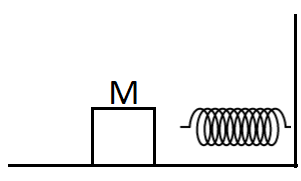
The block moves on a friction-free horizontal surface, so mechanical energy is conserved during its interaction with the ideal (mass-less) spring.
Step 1 : Relate the initial kinetic energy to the maximum spring potential energy.
When the block first touches the spring its speed is $$v_0$$.
At the instant the spring is compressed by the maximum amount $$L$$, the block momentarily comes to rest, so its kinetic energy becomes zero and the entire mechanical energy is stored in the spring:
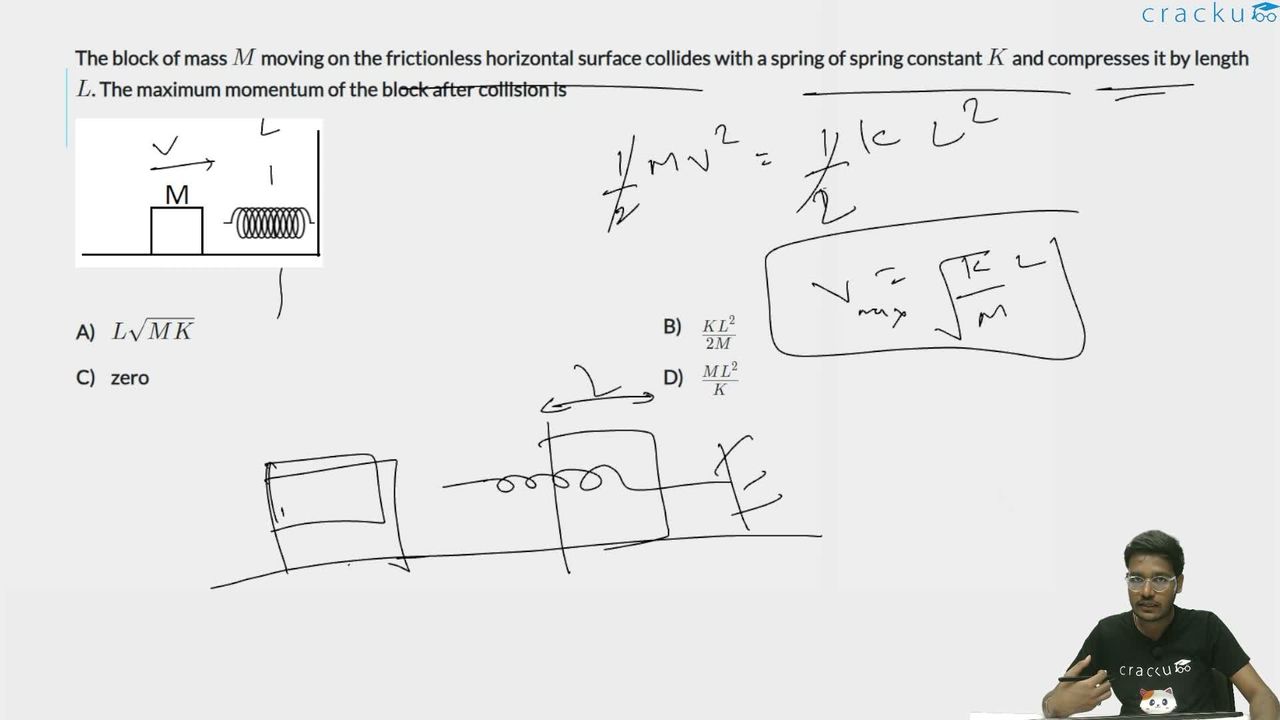
$$\frac12 M v_0^{\,2}= \frac12 K L^{\,2}\quad -(1)$$
Step 2 : Obtain the initial speed.
From $$-(1)$$,
$$v_0 = L\sqrt{\frac{K}{M}}\quad -(2)$$
Step 3 : Maximum momentum after the collision.
As the spring re-expands, it gives the block the same speed it had just before contact (but in the opposite direction).
Thus the largest magnitude of momentum during or after the collision equals the magnitude of the initial momentum:
$$p_{\max}= M v_0$$
Substituting $$-(2)$$,
$$p_{\max}=M\left(L\sqrt{\frac{K}{M}}\right)=L\sqrt{M K}\quad -(3)$$
Step 4 : Match with the given options.
Expression $$L\sqrt{M K}$$ is exactly the quantity written in Option A (after rearrangement of the factors inside the square root).
Therefore, the correct choice is:
Option A which is: $$L\sqrt{MK}$$
Was this solution helpful?
Click on the Email ☝️ to Watch the Video Solution
Create a FREE account and get:
_1.webp)

Educational materials for JEE preparation

Ask our AI anything

AI can make mistakes. Please verify important information.
AI can make mistakes. Please verify important information.
