
Join Our JEE Preparation Group
Prep with like-minded aspirants; Get access to free daily tests and study material.
Sign in
Please select an account to continue using cracku.in
↓ →
Join Our JEE Preparation Group
Prep with like-minded aspirants; Get access to free daily tests and study material.
A coil of self inductance $$L$$ is connected at one end of two rails as shown in figure. A connector of length $$l$$, mass $$m$$ can slide freely over the two parallel rails. The entire set up is placed in a magnetic field of induction $$B$$ going into the page. At an instant $$t=0$$ an initial velocity $$v_0$$ is imparted to it and as a result of that it starts moving along $$x$$-axis. The displacement of the connector is represented by the figure.
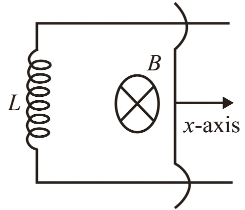
Given initial conditions: $$x(0) = 0$$, $$v(0) = v_0$$, $$i(0) = 0$$
$$\varepsilon = Blv = Bl\frac{dx}{dt}$$
$$\varepsilon = L\frac{di}{dt} \implies Bl\frac{dx}{dt} = L\frac{di}{dt}$$
Integrating: $$Blx = Li \implies i = \frac{Blx}{L}$$
Equation of motion: $$m\frac{d^2x}{dt^2} = -iBl = -\frac{B^2l^2}{L}x \implies \frac{d^2x}{dt^2} + \left(\frac{B^2l^2}{mL}\right)x = 0$$
Solving SHM: $$x(t) = \frac{v_0}{\omega}\sin(\omega t)$$ where $$\omega = \frac{Bl}{\sqrt{mL}}$$
Was this solution helpful?
Create a FREE account and get:
_1.webp)

Educational materials for JEE preparation

Ask our AI anything

AI can make mistakes. Please verify important information.
AI can make mistakes. Please verify important information.
