Sign in
Please select an account to continue using cracku.in
↓ →

Join Our JEE Preparation Group
Prep with like-minded aspirants; Get access to free daily tests and study material.
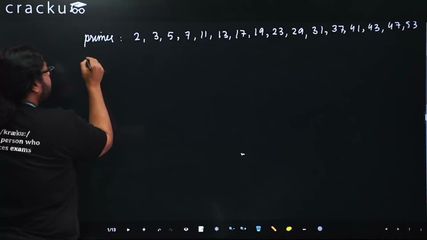
Starting from the number $$1$$, Ritu generates a series of numbers as $$1,3,6,11,18,29,42,\ldots$$ such that the differences of the consecutive numbers from the beginning give consecutive primes. In this series she came across a perfect square for the first time. The square root of this perfect square is
Starting with $$1$$, add the consecutive primes $$2,3,5,7,11,\ldots$$. The terms obtained are $$1,3,6,11,18,29,42,59,78,101,130,161,198,239,282,329,382,441$$. The first new perfect square is $$441=21^2$$, so its square root is $$21$$.
Was this solution helpful?
Click on the Email ☝️ to Watch the Video Solution
_1.webp)
Predict your JEE Main percentile, rank & performance in seconds

Educational materials for JEE preparation

Ask our AI anything

AI can make mistakes. Please verify important information.
AI can make mistakes. Please verify important information.
 91- 6303239042