
Join Our JEE Preparation Group
Prep with like-minded aspirants; Get access to free daily tests and study material.
Sign in
Please select an account to continue using cracku.in
↓ →
Join Our JEE Preparation Group
Prep with like-minded aspirants; Get access to free daily tests and study material.
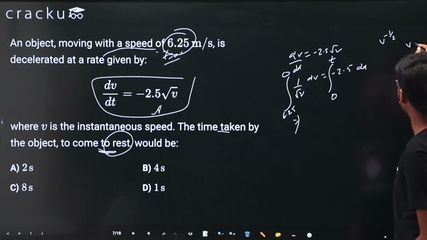
An object, moving with a speed of $$6.25 \, \text{m/s}$$, is decelerated at a rate given by: $$$\frac{dv}{dt} = -2.5\sqrt{v}$$$ where $$v$$ is the instantaneous speed. The time taken by the object, to come to rest, would be:
The problem provides the deceleration rate of the object as a function of its instantaneous speed ($$v$$):
$$\frac{dv}{dt} = -2.5 \cdot \sqrt{v}$$
To solve for time ($$t$$), we rearrange the equation using the separation of variables method, grouping all terms involving velocity ($$v$$) on one side and time ($$t$$) on the other side:
$$\frac{1}{\sqrt{v}} \cdot dv = -2.5 \cdot dt$$
$$v^{-\frac{1}{2}} \cdot dv = -2.5 \cdot dt$$
We apply definite integration on both sides matching the physical constraints of the motion:
Setting up the integration boundaries:
$$\int_{6.25}^{0} v^{-\frac{1}{2}} \cdot dv = \int_{0}^{t} -2.5 \cdot dt$$
Using the power rule for integration ($$\int v^n \cdot dv = \frac{v^{n+1}}{n+1}$$):
$$\left[ \frac{v^{\frac{1}{2}}}{\frac{1}{2}} \right]_{6.25}^{0} = -2.5 \cdot [t]_{0}^{t}$$
$$2 \cdot \left[ \sqrt{v} \right]_{6.25}^{0} = -2.5 \cdot (t - 0)$$
Substitute the upper and lower boundary values into the equation:
$$2 \cdot (\sqrt{0} - \sqrt{6.25}) = -2.5 \cdot t$$
Since $$\sqrt{6.25} = 2.5$$:
$$2 \cdot (0 - 2.5) = -2.5 \cdot t$$
$$-5 = -2.5 \cdot t$$
Isolating the time variable ($$t$$):
$$t = \frac{-5}{-2.5} = 2 \,\, \text{s}$$
Concept Check: Because the deceleration rate is non-linear and depends directly on $$\sqrt{v}$$, the slowing force reduces continuously as the speed drops, resulting in a smooth stop in exactly 2 seconds.
Correct Option Key: Option A ($2 \,\, \text{s}$)
Was this solution helpful?
Click on the Email ☝️ to Watch the Video Solution
Create a FREE account and get:
_1.webp)

Educational materials for JEE preparation

Ask our AI anything

AI can make mistakes. Please verify important information.
AI can make mistakes. Please verify important information.


