
Join Our JEE Preparation Group
Prep with like-minded aspirants; Get access to free daily tests and study material.
Sign in
Please select an account to continue using cracku.in
↓ →
Join Our JEE Preparation Group
Prep with like-minded aspirants; Get access to free daily tests and study material.
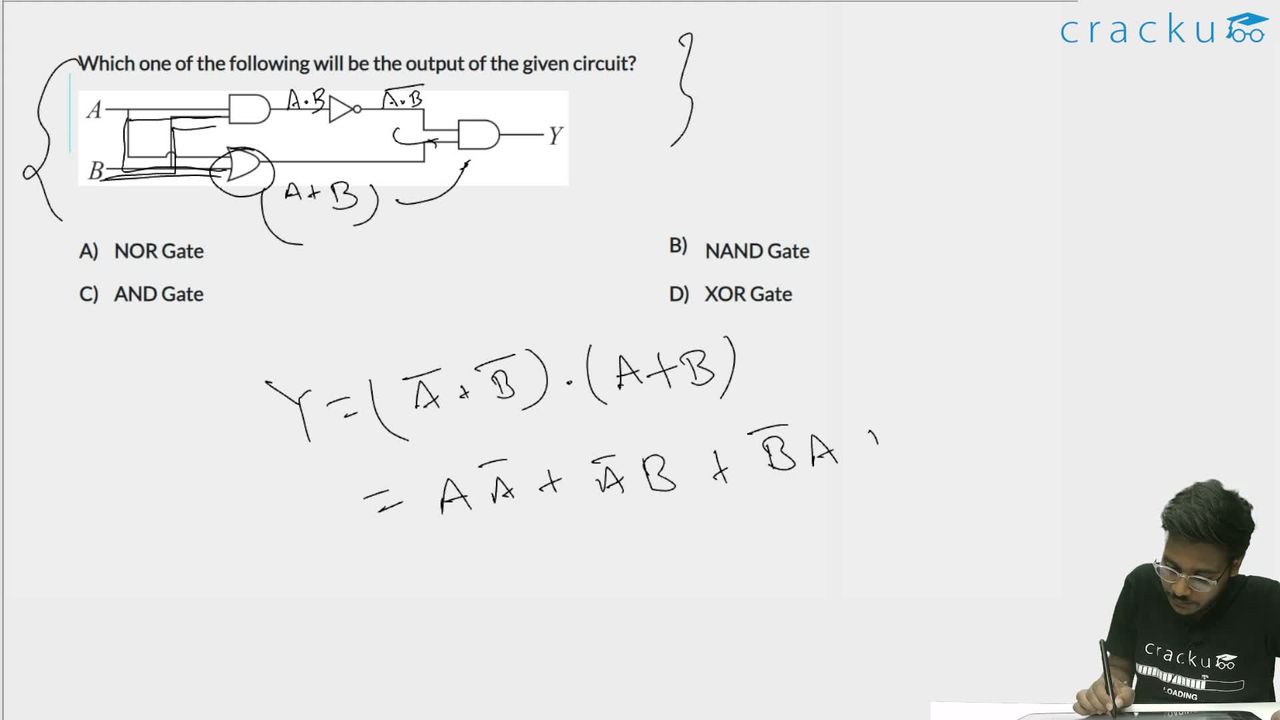
We need to determine the equivalent logic function for the given digital circuit combinations containing an AND gate, an OR gate, a NOT gate, and a final combination gate.
Output of the AND gate = $$A \cdot B$$
Output after the inverter = $$\overline{A \cdot B}$$
Output of the OR gate = $$A + B$$
The outputs from both the upper path ($$\overline{A \cdot B}$$) and the lower path ($$A + B$$) serve as the inputs to the final AND gate to produce the final system output $$Y$$:
$$Y = (\overline{A \cdot B}) \cdot (A + B)$$
According to De Morgan's Law, the term $$\overline{A \cdot B}$$ can be expanded as $$\bar{A} + \bar{B}$$. Substituting this back into the expression for $$Y$$ gives:
$$Y = (\bar{A} + \bar{B}) \cdot (A + B)$$
Distributing the terms across the brackets:
$$Y = \bar{A}A + \bar{A}B + \bar{B}A + \bar{B}B$$
Since the complement laws state that any variable ANDed with its inverse equals zero ($$\bar{A}A = 0$$ and $$\bar{B}B = 0$$), the equation simplifies directly to:
$$Y = 0 + \bar{A}B + A\bar{B} + 0$$
$$Y = A\bar{B} + \bar{A}B$$
The resulting boolean expression ($$A\bar{B} + \bar{A}B$$) is the standard definition of an exclusive-OR operation.
The logic circuit behaves exactly like an XOR Gate, which corresponds to Option D.
Click on the Email ☝️ to Watch the Video Solution
_1.webp)

Educational materials for JEE preparation

Ask our AI anything

AI can make mistakes. Please verify important information.
AI can make mistakes. Please verify important information.


