For the following questions answer them individually
The velocity of a particle is $$v = (v_0 + gt + Ft^2)$$ m s$$^{-1}$$. Its position is $$x = 0$$ at $$t = 0$$; then its displacement after time ($$t = 1$$ s) is:
Two identical blocks $$A$$ and $$B$$ each of mass $$m$$ resting on the smooth horizontal floor are connected by a light spring of natural length $$L$$ and spring constant $$K$$. A third block $$C$$ of mass $$m$$ moving with a speed $$v$$ along the line joining $$A$$ and $$B$$ collides with $$A$$. The maximum compression in the spring is:
A rubber ball is released from a height of 5 m above the floor. It bounces back repeatedly, always rising to $$\frac{81}{100}$$ of the height through which it falls. Find the average speed of the ball. (Take $$g = 10$$ m s$$^{-2}$$)
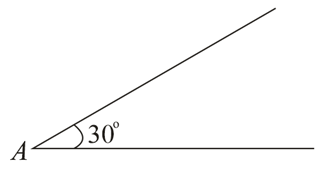
A sphere of mass 2 kg and radius 0.5 m is rolling with an initial speed of 1 m s$$^{-1}$$ goes up an inclined plane which makes an angle of 30° with the horizontal plane, without slipping. How low will the sphere take to return to the starting point $$A$$?
A geostationary satellite is orbiting around an arbitrary planet $$P$$ at a height of $$11R$$ above the surface of $$P$$, $$R$$ being the radius of $$P$$. The time period of another satellite in hours at a height of $$2R$$ from the surface of $$P$$ is ________. has the time period of 24 hours.
An object is located at 2 km beneath the surface of the water. If the fractional compression $$\frac{\Delta V}{V}$$ is 1.36%, the ratio of hydraulic stress to the corresponding hydraulic strain will be ________. [Given: density of water is 1000 kg m$$^{-3}$$ and $$g = 9.8$$ m s$$^{-2}$$].
Which one is the correct option for the two different thermodynamic processes?
If one mole of the polyatomic gas is having two vibrational modes and $$\beta$$ is the ratio of molar specific heats for polyatomic gas $$\left(\beta = \frac{C_p}{C_v}\right)$$ then the value of $$\beta$$ is:
A block of mass 1 kg attached to a spring is made to oscillate with an initial amplitude of 12 cm. After 2 minutes the amplitude decreases to 6 cm. Determine the value of the damping constant for this motion. (take $$\ln 2 = 0.693$$)
Two particles $$A$$ and $$B$$ of equal masses are suspended from two massless springs of spring constants $$K_1$$ and $$K_2$$ respectively. If the maximum velocities during oscillations are equal, the ratio of the amplitude of $$A$$ and $$B$$ is:
A sound wave of frequency 245 Hz travels with the speed of 300 m s$$^{-1}$$ along the positive x-axis. Each point of the wave moves to and fro through a total distance of 6 cm. What will be the mathematical expression of this travelling wave?
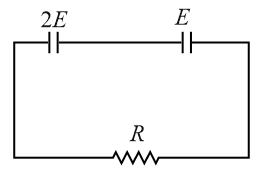
Two cells of emf $$2E$$ and $$E$$ with internal resistance $$r_1$$ and $$r_2$$ respectively are connected in series to an external resistor $$R$$ (see figure). The value of $$R$$, at which the potential difference across the terminals of the first cell becomes zero is:
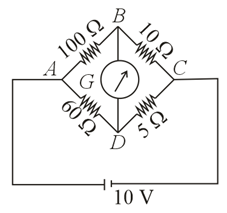
The four arms of a Wheatstone bridge have resistances as shown in the figure. A galvanometer of 15$$\Omega$$ resistance is connected across BD. Calculate the current through the galvanometer when a potential difference of 10 V is maintained across AC.
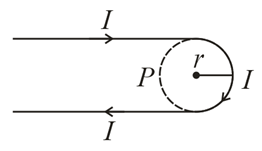
A hairpin like shape as shown in figure is made by bending a long current carrying wire. What is the magnitude of a magnetic field at point $$P$$ which lies on the centre of the semicircle?
Match List-I with List-II:
    List-I |                                                                       List-II
a. Phase difference between current and voltage in a purely resistive AC circuit |Â Â Â Â Â i. $$\frac{\pi}{2}$$; current leads voltage
b. Phase difference between current and voltage in a pure inductive AC circuit |Â Â Â Â Â Â ii. zero
c. Phase difference between current and voltage in a pure capacitive AC circuit |Â Â Â Â Â iii. $$\frac{\pi}{2}$$; current lags voltage
d. Phase difference between current and voltage in an LCR series circuit |Â Â Â Â Â Â Â Â Â Â iv. $$\tan^{-1}\left(\frac{X_C - X_L}{R}\right)$$
Choose the most appropriate answer from the options given below:
What happens to the inductive reactance and the current in a purely inductive circuit if the frequency is halved?
Two identical photocathodes receive the light of frequencies $$f_1$$ and $$f_2$$ respectively. If the velocities of the photo-electrons coming out are $$v_1$$ and $$v_2$$ respectively, then:
The atomic hydrogen emits a line spectrum consisting of various series. Which series of hydrogen atomic spectra is lying in the visible region?
Which one of the following will be the output of the given circuit?
A carrier signal $$C(t) = 25\sin(2.512 \times 10^{10}t)$$ is amplitude modulated by a message signal $$m(t) = 5\sin(1.57 \times 10^{8}t)$$ and transmitted through an antenna. What will be the bandwidth of the modulated signal?
A body of mass 1 kg rests on a horizontal floor with which it has a coefficient of static friction $$\frac{1}{\sqrt{3}}$$. It is desired to make the body move by applying the minimum possible force $$F$$ N. The value of $$F$$ will be ________. (Round off to the Nearest Integer) [Take $$g = 10$$ m s$$^{-2}$$]
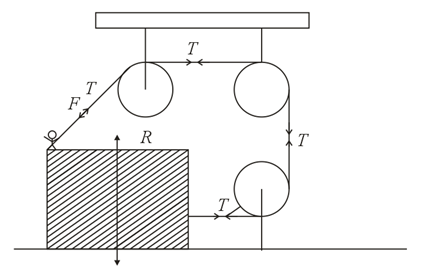
A boy of mass 4 kg is standing on a piece of wood having mass 5 kg. If the coefficient of friction between the wood and the floor is 0.5, the maximum force that the boy can exert on the rope so that the piece of wood does not move from its place is ________ N. (Round off to the Nearest Integer) [Take $$g = 10$$ m s$$^{-2}$$]
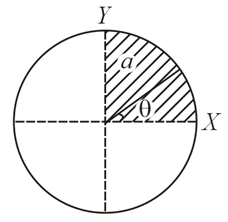
The disc of mass $$M$$ with uniform surface mass density $$\sigma$$ is shown in the figure. The center of mass of the quarter disc (the shaded area) is at the position $$\left(\frac{xa}{3\pi}, \frac{xa}{3\pi}\right)$$ where $$x$$ is ________. (Round off to the Nearest Integer) [$$a$$ is an area as shown in the figure]
Suppose you have taken a dilute solution of oleic acid in such a way that its concentration becomes 0.01 cm$$^3$$ of oleic acid per cm$$^3$$ of the solution. Then you make a thin film of this solution (monomolecular thickness) of area 4 cm$$^2$$ by considering 100 spherical drops of radius $$\left(\frac{3}{40\pi}\right)^{1/3} \times 10^{-3}$$ cm. Then the thickness of oleic acid layer will be $$x \times 10^{-14}$$ m. Where $$x$$ is ________.
The electric field intensity produced by the radiation coming from a 100 W bulb at a distance of 3 m is $$E$$. The electric field intensity produced by the radiation coming from 60 W at the same distance is $$\sqrt{\frac{x}{5}}E$$. Where the value of $$x$$ is ________.
The electric field in a region is given by $$\vec{E} = \frac{2}{5}E_0\hat{i} + \frac{3}{5}E_0\hat{j}$$ with $$E_0 = 4.0 \times 10^3$$ N C$$^{-1}$$. The flux of this field through a rectangular surface, area 0.4 m$$^2$$ parallel to the $$Y-Z$$ plane is ________ N m$$^2$$ C$$^{-1}$$.
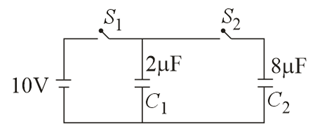
A 2$$\mu$$F capacitor $$C_1$$ is first charged to a potential difference of 10 V using a battery. Then the battery is removed and the capacitor is connected to an uncharged capacitor $$C_2$$ of 8$$\mu$$F. The charge in $$C_2$$ on equilibrium condition is ________ $$\mu$$C. (Round off to the Nearest Integer)
Seawater at a frequency $$f = 9 \times 10^2$$ Hz, has permittivity $$\varepsilon = 80\varepsilon_0$$ and resistivity $$\rho = 0.25$$ $$\Omega$$ m. Imagine a parallel plate capacitor is immersed in seawater and is driven by an alternating voltage source $$V(t) = V_0 \sin(2\pi ft)$$. Then the conduction current density becomes $$10^x$$ times the displacement current density after time $$t = \frac{1}{800}$$ s. The value of $$x$$ is ________. (Given: $$\frac{1}{4\pi\varepsilon_0} = 9 \times 10^9$$ N m$$^2$$ C$$^{-2}$$)
The image of an object placed in air formed by a convex refracting surface is at a distance of 10 m behind the surface. The image is real and is at $$\frac{2rd}{3}$$ of the distance of the object from the surface. The wavelength of light inside the surface is $$\frac{2}{3}$$ times the wavelength in air. The radius of the curved surface is $$\frac{x}{13}$$ m, the value of $$x$$ is ________.
A particle of mass $$m$$ moves in a circular orbit in a central potential field $$U(r) = U_0 r^4$$. If Bohr's quantization conditions are applied, radii of possible orbitals $$r_n$$ vary with $$n^{1/\alpha}$$, where $$\alpha$$ is ________.