
Join Our JEE Preparation Group
Prep with like-minded aspirants; Get access to free daily tests and study material.
Sign in
Please select an account to continue using cracku.in
↓ →
Join Our JEE Preparation Group
Prep with like-minded aspirants; Get access to free daily tests and study material.
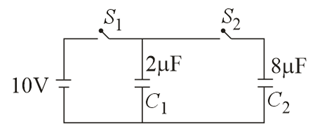
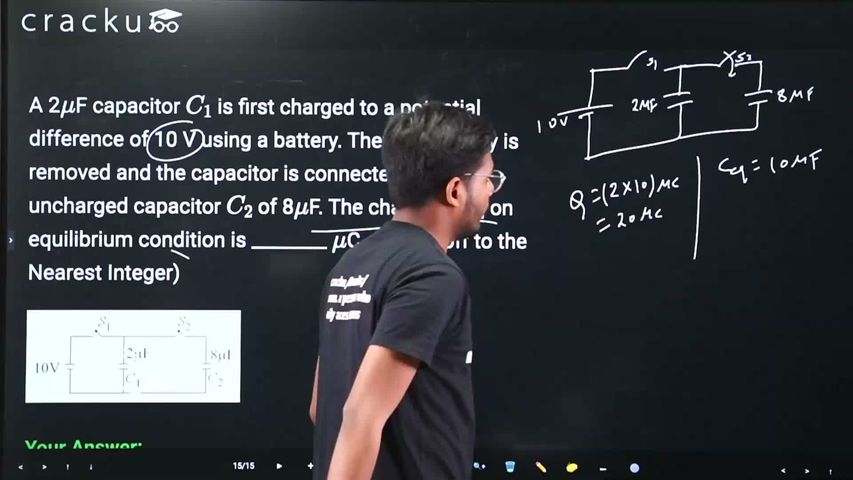
A 2$$\mu$$F capacitor $$C_1$$ is first charged to a potential difference of 10 V using a battery. Then the battery is removed and the capacitor is connected to an uncharged capacitor $$C_2$$ of 8$$\mu$$F. The charge in $$C_2$$ on equilibrium condition is ________ $$\mu$$C. (Round off to the Nearest Integer)
Correct Answer: 16
We need to determine the electric charge stored in the second capacitor ($$C_2$$) after reaching an equilibrium condition when connected to a previously charged capacitor ($$C_1$$).
Initially, only the first capacitor is connected to the voltage source while the second capacitor remains uncharged.
The initial charge ($$Q_{\text{total}}$$) stored in $$C_1$$ is calculated using the formula $$Q = C \times V$$:
$$Q_{\text{total}} = C_1 \times V = 2\ \mu\text{F} \times 10\text{ V} = 20\ \mu\text{C}$$
When the battery is disconnected and the charged capacitor $$C_1$$ is connected across the uncharged capacitor $$C_2 = 8\ \mu\text{F}$$, charge redistributes between them until both plates reach an identical common potential ($$V_c$$).
Since the capacitors are connected in a parallel-like configuration, the equivalent total capacitance ($$C_{\text{eq}}$$) of the system is:
$$C_{\text{eq}} = C_1 + C_2 = 2\ \mu\text{F} + 8\ \mu\text{F} = 10\ \mu\text{F}$$
According to the law of conservation of charge, the total charge remains the same. The common equilibrium potential is given by:
$$V_c = \frac{Q_{\text{total}}}{C_{\text{eq}}} = \frac{20\ \mu\text{C}}{10\ \mu\text{F}} = 2\text{ V}$$
Now that we know the common operating voltage across the system is $$2\text{ V}$$, we can find the final stable charge ($$Q_2$$) remaining on the second capacitor:
$$Q_2 = C_2 \times V_c$$
$$Q_2 = 8\ \mu\text{F} \times 2\text{ V} = 16\ \mu\text{C}$$
The total accumulated charge on the capacitor $$C_2$$ under equilibrium conditions is 16 $$\mu\text{C}$$.
Was this solution helpful?
Click on the Email ☝️ to Watch the Video Solution
Create a FREE account and get:
_1.webp)

Educational materials for JEE preparation

Ask our AI anything

AI can make mistakes. Please verify important information.
AI can make mistakes. Please verify important information.


