
Join Our JEE Preparation Group
Prep with like-minded aspirants; Get access to free daily tests and study material.
Sign in
Please select an account to continue using cracku.in
↓ →
Join Our JEE Preparation Group
Prep with like-minded aspirants; Get access to free daily tests and study material.
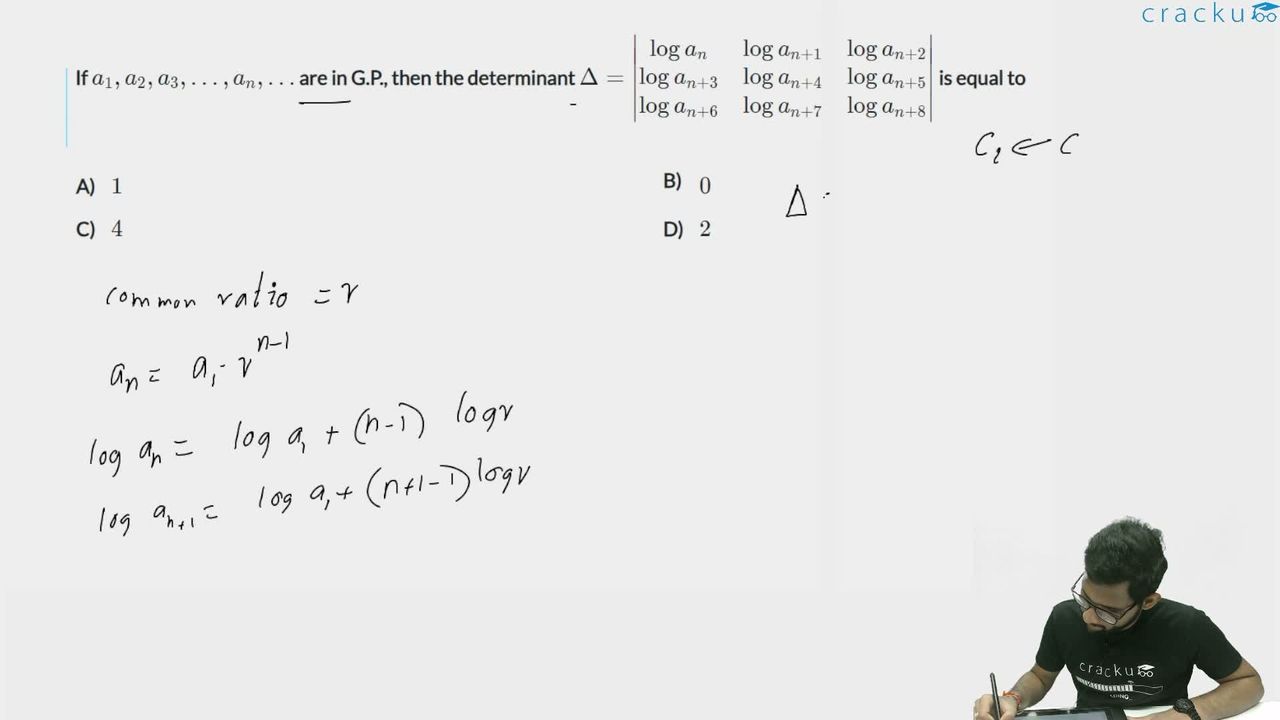
If $$a_1, a_2, a_3, \ldots, a_n, \ldots$$ are in G.P., then the determinant $$\Delta = \begin{vmatrix} \log a_n & \log a_{n+1} & \log a_{n+2} \\ \log a_{n+3} & \log a_{n+4} & \log a_{n+5} \\ \log a_{n+6} & \log a_{n+7} & \log a_{n+8} \end{vmatrix}$$ is equal to
We are given that the terms $$ a_1, a_2, a_3, \ldots $$ are in a Geometric Progression (G.P.).
Let the first term of the G.P. be $$ a $$ and the common ratio be $$ r $$.
The general term of a G.P. is given by the formula:
$$ a_m = a \cdot r^{m-1} $$
Step 1: Applying Logarithms
Taking the natural logarithm on both sides of the general term equation:
$$ \log a_m = \log(a \cdot r^{m-1}) $$
$$ \log a_m = \log a + \log(r^{m-1}) $$
$$ \log a_m = \log a + (m-1) \log r $$
This expression shows that the logarithms of terms in a G.P. form an Arithmetic Progression (A.P.).
The common difference of this progression is $$ \log r $$.
Step 2: Substituting into the Determinant
We substitute these logarithmic expressions into the given determinant:
$$ \Delta = \begin{vmatrix} \log a + (n-1)\log r & \log a + n\log r & \log a + (n+1)\log r \\ \log a + (n+2)\log r & \log a + (n+3)\log r & \log a + (n+4)\log r \\ \log a + (n+5)\log r & \log a + (n+6)\log r & \log a + (n+7)\log r \end{vmatrix} $$
Step 3: Column Operations
To simplify the matrix, we apply the following column operations:
$$ C_2 \to C_2 - C_1 $$
$$ C_3 \to C_3 - C_2 $$
Let us calculate the changes for the columns:
For the second column minus the first column:
$$ (\log a + n\log r) - (\log a + (n-1)\log r) = \log r $$
$$ (\log a + (n+3)\log r) - (\log a + (n+2)\log r) = \log r $$
$$ (\log a + (n+6)\log r) - (\log a + (n+5)\log r) = \log r $$
For the third column minus the second column:
$$ (\log a + (n+1)\log r) - (\log a + n\log r) = \log r $$
$$ (\log a + (n+4)\log r) - (\log a + (n+3)\log r) = \log r $$
$$ (\log a + (n+7)\log r) - (\log a + (n+6)\log r) = \log r $$
Substituting these simplified values back into the determinant gives:
$$ \Delta = \begin{vmatrix} \log a + (n-1)\log r & \log r & \log r \\ \log a + (n+2)\log r & \log r & \log r \\ \log a + (n+5)\log r & \log r & \log r \end{vmatrix} $$
Step 4: Evaluation
We can observe that the second column and the third column are completely identical.
According to the properties of determinants, if any two rows or columns of a determinant are identical, the total value of the determinant is zero.
Therefore, the final value is: $$ \Delta = 0 $$
Was this solution helpful?
Click on the Email ☝️ to Watch the Video Solution
Create a FREE account and get:
_1.webp)

Educational materials for JEE preparation

Ask our AI anything

AI can make mistakes. Please verify important information.
AI can make mistakes. Please verify important information.
