
Join Our JEE Preparation Group
Prep with like-minded aspirants; Get access to free daily tests and study material.
Sign in
Please select an account to continue using cracku.in
↓ →
Join Our JEE Preparation Group
Prep with like-minded aspirants; Get access to free daily tests and study material.
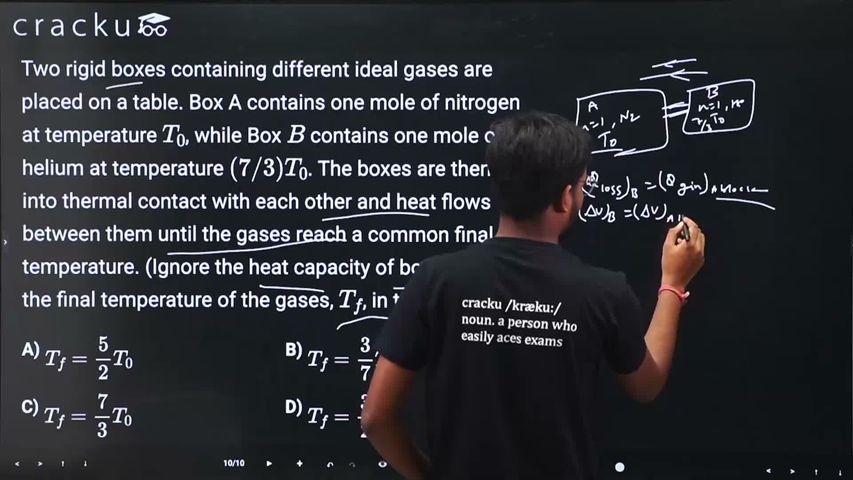
Two rigid boxes containing different ideal gases are placed on a table. Box A contains one mole of nitrogen at temperature $$T_0$$, while Box $$B$$ contains one mole of helium at temperature $$(7/3)T_0$$. The boxes are then put into thermal contact with each other and heat flows between them until the gases reach a common final temperature. (Ignore the heat capacity of boxes). Then, the final temperature of the gases, $$T_f$$, in terms of $$T_0$$ is
We are given two rigid boxes containing different ideal gases that are brought into thermal contact. Since the boxes are rigid and we ignore their heat capacity, the volume of both gases remains constant ($$\Delta W = 0$$), and no heat is lost to the surroundings.
Let us identify the molar heat capacity at constant volume ($$C_v$$) for both gases based on their molecular structure:
$$C_{v1} = \frac{5}{2}R$$
Given: Moles ($$n_1$$) = $$1 \,\, \text{mole}$$, Initial Temperature ($$T_1$$) = $$T_0$$
$$C_{v2} = \frac{3}{2}R$$
Given: Moles ($$n_2$$) = $$1 \,\, \text{mole}$$, Initial Temperature ($$T_2$$) = $$\frac{7}{3}T_0$$
According to the law of conservation of energy, the total internal energy of the isolated system remains constant. Therefore, the heat lost by the hotter gas (Helium) must be exactly equal to the heat gained by the cooler gas (Nitrogen) until they reach a common final temperature ($$T_f$$):
$$\Delta Q_{\text{gained}} = \Delta Q_{\text{lost}}$$
$$n_1 \cdot C_{v1} \cdot (T_f - T_1) = n_2 \cdot C_{v2} \cdot (T_2 - T_f)$$
Plugging our gas constants and initial conditions into the equilibrium equation:
$$1 \cdot \left(\frac{5}{2}R\right) \cdot (T_f - T_0) = 1 \cdot \left(\frac{3}{2}R\right) \cdot \left(\frac{7}{3}T_0 - T_f\right)$$
Cancel out the common factor $$\frac{1}{2}R$$ from both sides to simplify the algebra:
$$5 \cdot (T_f - T_0) = 3 \cdot \left(\frac{7}{3}T_0 - T_f\right)$$
Expand the brackets on both sides:
$$5T_f - 5T_0 = 7T_0 - 3T_f$$
Group all terms containing the final temperature ($$T_f$$) on the left side and initial reference temperature ($$T_0$$) terms on the right side:
$$5T_f + 3T_f = 7T_0 + 5T_0$$
$$8T_f = 12T_0$$
Isolate the final temperature variable ($$T_f$$):
$$T_f = \frac{12}{8}T_0 = \frac{3}{2}T_0$$
Concept Check: Because diatomic nitrogen possesses more degrees of freedom per molecule than monatomic helium, it requires more energy to change its temperature by one Kelvin. As a result, the final equilibrium point settles closer to nitrogen's lower initial temperature than a simple arithmetic mean would predict.
Correct Option Key: Option D ($$T_f = \frac{3}{2}T_0$$)
Was this solution helpful?
Click on the Email ☝️ to Watch the Video Solution
Create a FREE account and get:
_1.webp)

Educational materials for JEE preparation

Ask our AI anything

AI can make mistakes. Please verify important information.
AI can make mistakes. Please verify important information.
