
Join Our JEE Preparation Group
Prep with like-minded aspirants; Get access to free daily tests and study material.
Sign in
Please select an account to continue using cracku.in
↓ →
Join Our JEE Preparation Group
Prep with like-minded aspirants; Get access to free daily tests and study material.
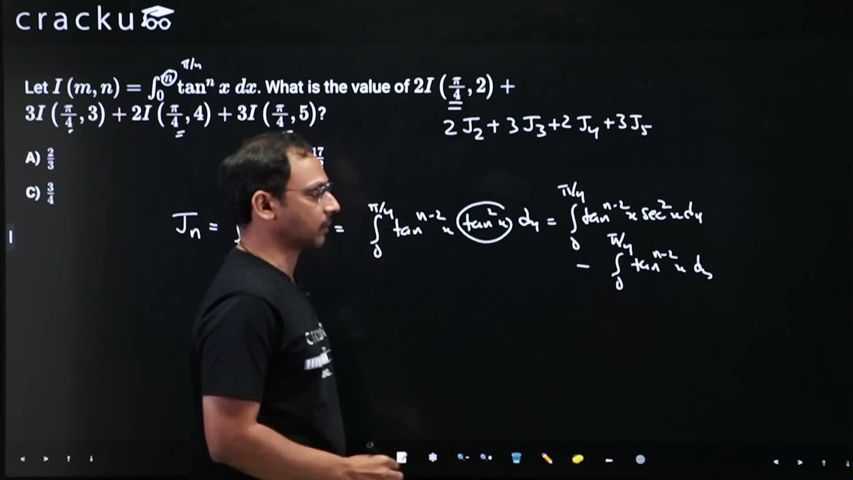
Let $$I\left(m,n\right)=\int_0^m\tan^nx\ dx$$. What is the value of $$2I\left(\frac{\ \pi\ }{4},2\right)+3I\left(\frac{\ \pi\ }{4},3\right)+2I\left(\frac{\ \pi\ }{4},4\right)+3I\left(\frac{\ \pi\ }{4},5\right)$$?
To evaluate the expression efficiently, let us use the standard reduction formula for $$I(n) = \int_0^{\pi/4} \tan^n x \, dx$$.
We know that for $$n \ge 2$$:
$$I(n) + I(n-2) = \int_0^{\pi/4} (\tan^n x + \tan^{n-2} x) \, dx = \int_0^{\pi/4} \tan^{n-2} x (\sec^2 x) \, dx$$
Using substitution $$u = \tan x$$, $$du = \sec^2 x \, dx$$:
$$I(n) + I(n-2) = \left[ \frac{\tan^{n-1} x}{n-1} \right]_0^{\pi/4} = \frac{1}{n-1}$$
Thus, we have the identity:
$$I(n) + I(n-2) = \frac{1}{n-1}$$
We need to find the value of:
$$S = 2I\left(\frac{\pi}{4}, 2\right) + 3I\left(\frac{\pi}{4}, 3\right) + 2I\left(\frac{\pi}{4}, 4\right) + 3I\left(\frac{\pi}{4}, 5\right)$$
Let us group the terms using $$I(n) + I(n-2) = \frac{1}{n-1}$$:
Adding these two results together:
$$S = \frac{2}{3} + \frac{3}{4} = \frac{8 + 9}{12} = \frac{17}{12}$$
The correct option is B.
Was this solution helpful?
Click on the Email ☝️ to Watch the Video Solution
Create a FREE account and get:
_1.webp)

Educational materials for JEE preparation

Ask our AI anything

AI can make mistakes. Please verify important information.
AI can make mistakes. Please verify important information.
