
Join Our JEE Preparation Group
Prep with like-minded aspirants; Get access to free daily tests and study material.
Sign in
Please select an account to continue using cracku.in
↓ →
Join Our JEE Preparation Group
Prep with like-minded aspirants; Get access to free daily tests and study material.
The number of ways, in which the letters A, B, C, D, E can be placed in the 8 boxes of the figure below so that no row remains empty and at most one letter can be placed in a box, is :
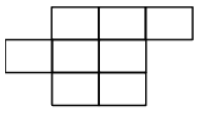
To find the number of ways to place the letters A, B, C, D, and E into the 8 boxes such that no row remains empty, we first determine the number of ways to select 5 boxes from the grid under this constraint, and then arrange the 5 distinct letters within those selected boxes.
The grid consists of 8 boxes distributed across 3 horizontal rows with the configuration of 3 boxes in the top row, 2 boxes in the middle row, and 3 boxes in the bottom row:
$$\text{Row 1} = 3 \text{ boxes}, \quad \text{Row 2} = 2 \text{ boxes}, \quad \text{Row 3} = 3 \text{ boxes}$$
Let $$r_1, r_2,$$ and $$r_3$$ be the number of boxes selected from Row 1, Row 2, and Row 3 respectively. We need to choose a total of 5 boxes ($$r_1 + r_2 + r_3 = 5$$) such that no row is empty ($$r_1, r_2, r_3 \ge 1$$).
---
Step 1: List the possible distributions $$(r_1, r_2, r_3)$$ of selecting the 5 boxes
Case 1: When 1 box is selected from the middle row ($$r_2 = 1$$)
The remaining 4 boxes must be chosen from the top and bottom rows ($$r_1 + r_3 = 4$$):
Distribution (3, 1, 1): $$\binom{3}{3} \times \binom{2}{1} \times \binom{3}{1} = 1 \times 2 \times 3 = 6 \text{ ways}$$
Distribution (2, 1, 2): $$\binom{3}{2} \times \binom{2}{1} \times \binom{3}{2} = 3 \times 2 \times 3 = 18 \text{ ways}$$
Distribution (1, 1, 3): $$\binom{3}{1} \times \binom{2}{1} \times \binom{3}{3} = 3 \times 2 \times 1 = 6 \text{ ways}$$
Case 2: When 2 boxes are selected from the middle row ($$r_2 = 2$$)
The remaining 3 boxes must be chosen from the top and bottom rows ($$r_1 + r_3 = 3$$):
Distribution (2, 2, 1): $$\binom{3}{2} \times \binom{2}{2} \times \binom{3}{1} = 3 \times 1 \times 3 = 9 \text{ ways}$$
Distribution (1, 2, 2): $$\binom{3}{1} \times \binom{2}{2} \times \binom{3}{2} = 3 \times 1 \times 3 = 9 \text{ ways}$$
---
Step 2: Calculate the total number of ways to select the 5 boxes
Summing the ways from all valid distributions:
$$\text{Total box selections} = 6 + 18 + 6 + 9 + 9 = 48 \text{ ways}$$
---
Step 3: Arrange the 5 distinct letters in the selected boxes
The 5 distinct letters (A, B, C, D, E) can be arranged in the 5 chosen boxes in $$5!$$ ways:
$$5! = 5 \times 4 \times 3 \times 2 \times 1 = 120 \text{ ways}$$
---
Step 4: Compute the final number of placements
$$\text{Total number of ways} = 48 \times 120 = 5760$$
Therefore, the total number of ways to place the letters is equal to 5760.
Was this solution helpful?
Click on the Email ☝️ to Watch the Video Solution
Create a FREE account and get:
_1.webp)

Educational materials for JEE preparation

Ask our AI anything

AI can make mistakes. Please verify important information.
AI can make mistakes. Please verify important information.


