
Join Our JEE Preparation Group
Prep with like-minded aspirants; Get access to free daily tests and study material.
Sign in
Please select an account to continue using cracku.in
↓ →
Join Our JEE Preparation Group
Prep with like-minded aspirants; Get access to free daily tests and study material.
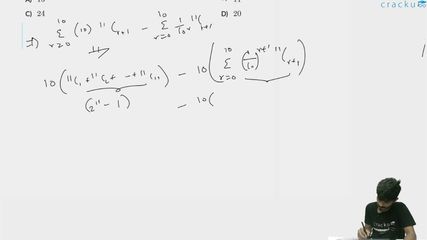
If $$\sum_{r=0}^{10} \left(\frac{10^{r+1} - 1}{10^r}\right) \cdot \,^{11}C_{r+1} = \frac{\alpha^{11} - 11^{11}}{10^{10}}$$, then $$\alpha$$ is equal to :
We begin by simplifying the fraction inside the summation:
$$\frac{10^{r+1}-1}{10^r} = \frac{10^{r+1}}{10^r} - \frac{1}{10^r} = 10 - 10^{-r}$$
Substituting this back into the sum, we can split it into two separate series:
$$S = \sum_{r=0}^{10} \left(10 - 10^{-r}\right) {}^{11}C_{r+1} = 10\sum_{r=0}^{10} {}^{11}C_{r+1} - \sum_{r=0}^{10} 10^{-r} \cdot {}^{11}C_{r+1}$$
To make things easier, let's use a change of variable. Let $$k = r + 1$$. As $$r$$ varies from $$0$$ to $$10$$, $$k$$ runs from $$1$$ to $$11$$:
$$
\begin{aligned}
S = 10\sum_{k=1}^{11} {}^{11}C_k - \sum_{k=1}^{11} 10^{-(k-1)} {}^{11}C_k && \text{(1)}
\end{aligned}
$$
Using the standard binomial theorem identity $$\sum_{k=0}^{11} {}^{11}C_k = 2^{11}$$, we subtract the missing $$k=0$$ term ($${}^{11}C_0 = 1$$):
$$\sum_{k=1}^{11} {}^{11}C_k = 2^{11} - {}^{11}C_0 = 2^{11} - 1$$
Multiplying by the constant factor of $$10$$:
$$10\sum_{k=1}^{11} {}^{11}C_k = 10\left(2^{11} - 1\right) = 10(2048 - 1) = 20470 \tag{2}$$
We rewrite the exponent $$10^{-(k-1)}$$ as $$10 \cdot 10^{-k}$$:
$$\sum_{k=1}^{11} 10^{-(k-1)} {}^{11}C_k = 10\sum_{k=1}^{11} 10^{-k} {}^{11}C_k$$
Using the binomial expansion formula $$(1+x)^{11} = \sum_{k=0}^{11} {}^{11}C_k x^k$$ with $$x = \frac{1}{10}$$:
$$\sum_{k=1}^{11} {}^{11}C_k 10^{-k} = \left(1 + \frac{1}{10}\right)^{11} - {}^{11}C_0 = \left(\frac{11}{10}\right)^{11} - 1$$
Now, multiply this by $$10$$:
$$\sum_{k=1}^{11} 10^{-(k-1)} {}^{11}C_k = 10\left[\left(\frac{11}{10}\right)^{11} - 1\right] = 10 \cdot \frac{11^{11}}{10^{11}} - 10 = \frac{11^{11}}{10^{10}} - 10 \tag{3}$$
Substitute equation (2) and equation (3) back into the primary expression for $$S$$ (Equation 1):
$$S = 20470 - \left( \frac{11^{11}}{10^{10}} - 10 \right)$$ $$S = 20470 + 10 - \frac{11^{11}}{10^{10}}$$ $$S = 20480 - \frac{11^{11}}{10^{10}}$$
To match the target format given in the problem, let's establish a common denominator of $$10^{10}$$:
$$S = \frac{20480 \cdot 10^{10} - 11^{11}}{10^{10}}$$
We are given that:
$$S = \frac{\alpha^{11} - 11^{11}}{10^{10}}$$
By comparing the numerators directly:
$$\alpha^{11} = 20480 \cdot 10^{10}$$
Since $$2048 = 2^{11}$$, we can rewrite $$20480$$ as $$2^{11} \cdot 10$$:
$$\alpha^{11} = (2^{11} \cdot 10) \cdot 10^{10}$$ $$\alpha^{11} = 2^{11} \cdot 10^{11}$$ $$\alpha^{11} = (2 \cdot 10)^{11} = 20^{11}$$
Taking the $$11\text{-th}$$ root on both sides:
$$\alpha = 20$$
Option D (20)
Was this solution helpful?
Click on the Email ☝️ to Watch the Video Solution
Create a FREE account and get:
_1.webp)

Educational materials for JEE preparation

Ask our AI anything

AI can make mistakes. Please verify important information.
AI can make mistakes. Please verify important information.


