
Join Our JEE Preparation Group
Prep with like-minded aspirants; Get access to free daily tests and study material.
Sign in
Please select an account to continue using cracku.in
↓ →
Join Our JEE Preparation Group
Prep with like-minded aspirants; Get access to free daily tests and study material.
If $$\lim_{x \to 0} \frac{\cos(2x) + a\cos(4x) - b}{x^4}$$ is finite, then $$(a + b)$$ is equal to :
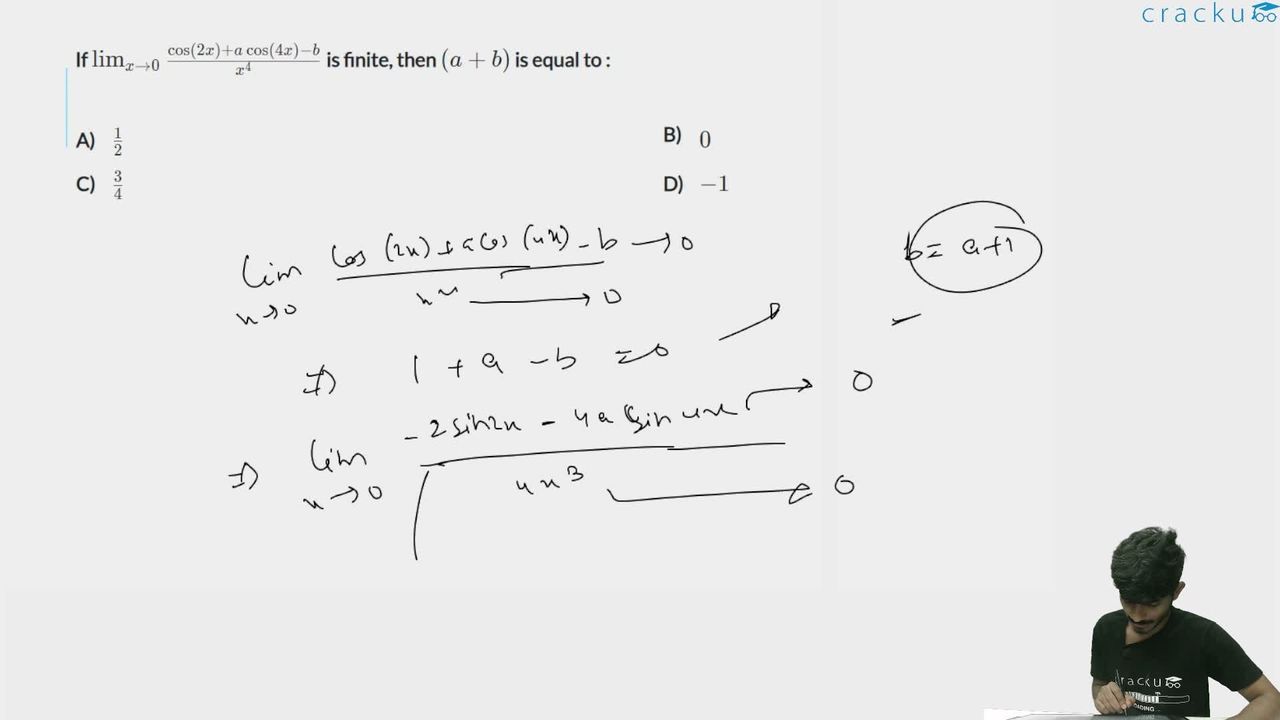
We want the limit $$\displaystyle \lim_{x \to 0}\frac{\cos(2x)+a\cos(4x)-b}{x^{4}}$$ to remain finite.
For this to happen, every term of order lower than $$x^{4}$$ in the numerator must vanish so that the first non-zero term is at least of order $$x^{4}$$.
Use the Maclaurin series of cosine:
$$\cos(kx)=1-\frac{k^{2}x^{2}}{2}+\frac{k^{4}x^{4}}{24}+O(x^{6}).$$
Expand each cosine up to $$x^{4}$$:
• $$\cos(2x)=1-\frac{(2)^{2}x^{2}}{2}+\frac{(2)^{4}x^{4}}{24}=1-2x^{2}+\frac{2x^{4}}{3}.$$
• $$\cos(4x)=1-\frac{(4)^{2}x^{2}}{2}+\frac{(4)^{4}x^{4}}{24}=1-8x^{2}+\frac{32x^{4}}{3}.$$
Substitute these into the numerator $$N(x)$$:
$$\begin{aligned} N(x)&=\bigl[1-2x^{2}+\frac{2x^{4}}{3}\bigr] +a\bigl[1-8x^{2}+\frac{32x^{4}}{3}\bigr]-b\\ &=(1+a-b)\;+\;(-2-8a)\,x^{2}\;+\;\Bigl(\frac{2}{3}+\frac{32a}{3}\Bigr)x^{4}+O(x^{6}). \end{aligned}$$
For $$N(x)$$ to start from at least the $$x^{4}$$ term, the constant term and the $$x^{2}$$ term must be zero:
$$1+a-b=0 \quad -(1)$$
$$-2-8a=0 \quad -(2)$$
Solve equation $$(2)$$ first:
$$-2-8a=0 \;\Rightarrow\; 8a=-2 \;\Rightarrow\; a=-\frac14.$$
Substitute $$a=-\tfrac14$$ into $$(1)$$:
$$1-\frac14-b=0 \;\Rightarrow\; \frac34-b=0 \;\Rightarrow\; b=\frac34.$$
Therefore $$a+b=-\frac14+\frac34=\frac12.$$
Hence the required value is $$\boxed{\tfrac12}$$, which corresponds to Option A.
Was this solution helpful?
Click on the Email ☝️ to Watch the Video Solution
Create a FREE account and get:
_1.webp)

Educational materials for JEE preparation

Ask our AI anything

AI can make mistakes. Please verify important information.
AI can make mistakes. Please verify important information.


