
Join Our JEE Preparation Group
Prep with like-minded aspirants; Get access to free daily tests and study material.
Sign in
Please select an account to continue using cracku.in
↓ →
Join Our JEE Preparation Group
Prep with like-minded aspirants; Get access to free daily tests and study material.
The flat base of a hemisphere of radius $$a$$ with no charge inside it lies in a horizontal plane. A uniform electric field $$\vec{E}$$ is applied at an angle $$\frac{\pi}{4}$$ with the vertical direction. The electric flux through the curved surface of the hemisphere is
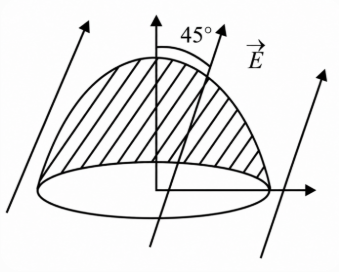
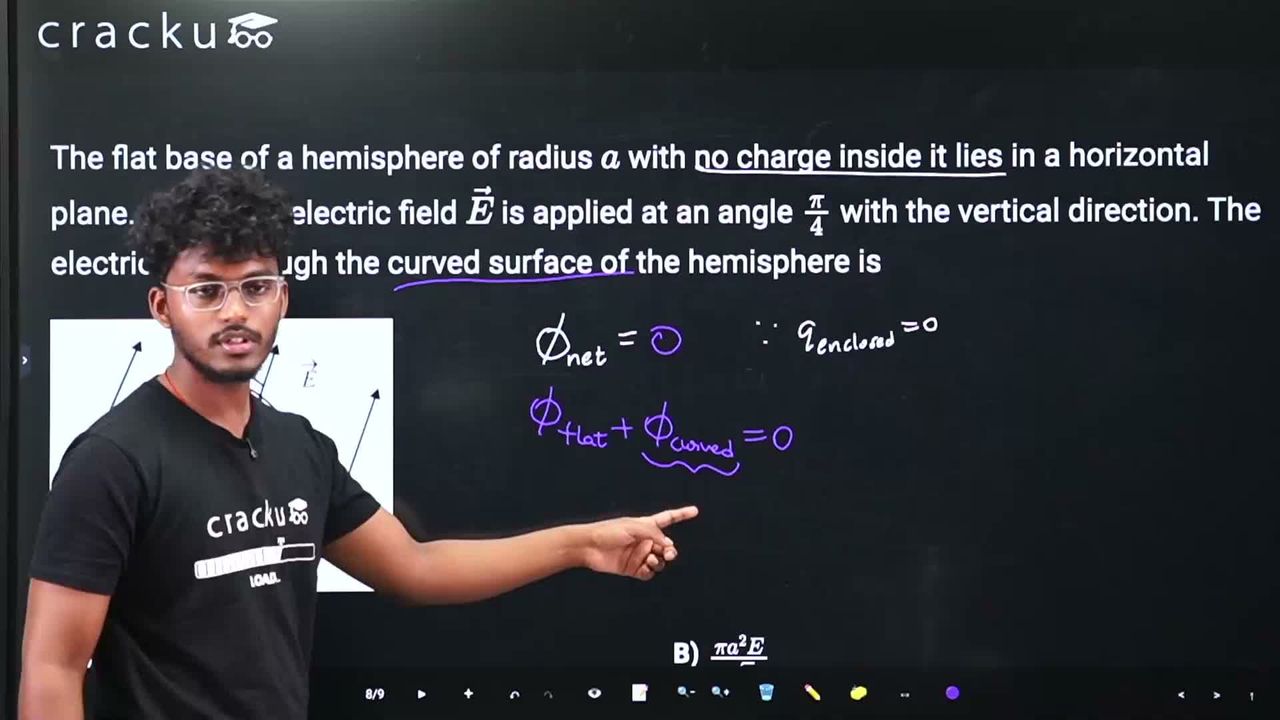
Let the hemisphere of radius $$a$$ form a closed surface by adding its flat circular base. Since no charge is enclosed, Gauss’s law gives
$$\Phi_{\text{total}} = \Phi_{\text{curved}} + \Phi_{\text{base}} = 0$$
Hence
$$\Phi_{\text{curved}} = -\,\Phi_{\text{base}} \quad -(1)$$
The base is a circle of area $$A = \pi a^{2}$$ lying in the horizontal plane. Its outward normal is vertical and directed downwards (away from the interior of the hemisphere).
The uniform electric field $$\vec E$$ makes an angle $$\frac{\pi}{4}$$ with the vertical. Therefore, the angle between $$\vec E$$ and the outward normal to the base is also $$\frac{\pi}{4}$$.
Flux through the base:
$$\Phi_{\text{base}} = \vec E \cdot \vec A = EA\cos\left(\frac{\pi}{4}\right) = E\bigl(\pi a^{2}\bigr)\,\frac{1}{\sqrt{2}} = \frac{\pi a^{2}E}{\sqrt{2}}$$
Substituting this value in equation (1):
$$\Phi_{\text{curved}} = -\left(\frac{\pi a^{2}E}{\sqrt{2}}\right)$$
The minus sign only indicates that the flux through the curved surface is opposite in sense to that through the base. Its magnitude—the quantity usually asked for—is
$$\boxed{\dfrac{\pi a^{2}E}{\sqrt{2}}}$$
Thus the required electric flux through the curved surface of the hemisphere corresponds to Option B.
Was this solution helpful?
Click on the Email ☝️ to Watch the Video Solution
Create a FREE account and get:
_1.webp)

Educational materials for JEE preparation

Ask our AI anything

AI can make mistakes. Please verify important information.
AI can make mistakes. Please verify important information.
