
Join Our JEE Preparation Group
Prep with like-minded aspirants; Get access to free daily tests and study material.
Sign in
Please select an account to continue using cracku.in
↓ →
Join Our JEE Preparation Group
Prep with like-minded aspirants; Get access to free daily tests and study material.
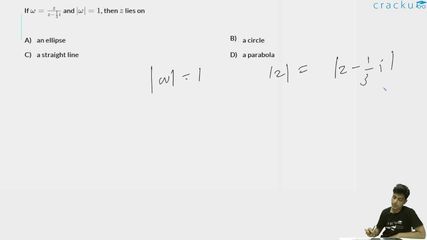
If $$\omega = \frac{z}{z - \frac{1}{3} i}$$ and $$|\omega| = 1$$, then $$z$$ lies on
Let $$z = x + iy$$ where $$x, y \in \mathbb{R}$$.
We are given $$\omega = \dfrac{z}{\,z - \dfrac{i}{3}\,}$$ and the condition $$|\omega| = 1$$.
Property used: For any two complex numbers $$a$$ and $$b$$, $$\left|\dfrac{a}{b}\right| = 1 \;\Longrightarrow\; |a| = |b|$$ (because $$|a/b| = |a|/|b|$$).
Applying this property, $$ \left|\dfrac{z}{\,z - \dfrac{i}{3}\,}\right| = 1 \;\Longrightarrow\; |z| = \left|z - \dfrac{i}{3}\right|. $$
In coordinate form, $$|z| = \sqrt{x^2 + y^2}$$ and $$\left|z - \dfrac{i}{3}\right| = \sqrt{x^2 + \left(y - \dfrac{1}{3}\right)^2}.$$ Setting them equal gives $$ \sqrt{x^2 + y^2} = \sqrt{x^2 + \left(y - \dfrac{1}{3}\right)^2}. $$
Squaring both sides: $$ x^2 + y^2 = x^2 + \left(y - \dfrac{1}{3}\right)^2. $$ Cancel $$x^2$$ and expand the right-hand side: $$ y^2 = y^2 - \dfrac{2y}{3} + \dfrac{1}{9}. $$ Subtract $$y^2$$ from both sides: $$ 0 = -\dfrac{2y}{3} + \dfrac{1}{9}. $$
Solve for $$y$$: $$ \dfrac{2y}{3} = \dfrac{1}{9} \;\Longrightarrow\; y = \dfrac{1}{6}. $$
Thus every point $$z = x + i\,y$$ satisfying the given condition has a fixed imaginary part $$y = \dfrac{1}{6}$$, while $$x$$ can be any real number. Hence the locus is the straight horizontal line $$ y = \dfrac{1}{6}. $$
Therefore $$z$$ lies on a straight line.
Option C which is: a straight line
Was this solution helpful?
Click on the Email ☝️ to Watch the Video Solution
Create a FREE account and get:
_1.webp)

Educational materials for JEE preparation

Ask our AI anything

AI can make mistakes. Please verify important information.
AI can make mistakes. Please verify important information.
