
Join Our JEE Preparation Group
Prep with like-minded aspirants; Get access to free daily tests and study material.
Sign in
Please select an account to continue using cracku.in
↓ →
Join Our JEE Preparation Group
Prep with like-minded aspirants; Get access to free daily tests and study material.
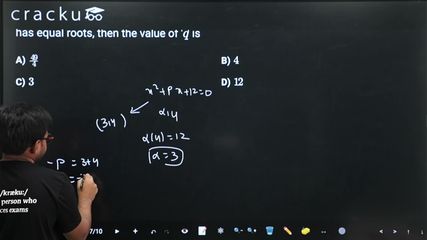
If one root of the equation $$x^2 + px + 12 = 0$$ is $$4$$, while the equation $$x^2 + px + q = 0$$ has equal roots, then the value of '$$q$$' is
Let the first quadratic equation be:
$$ x^2 + px + 12 = 0 $$
Since 4 is a root of this equation, it must satisfy it. Substitute $$ x = 4 $$ into the equation:
$$ (4)^2 + p(4) + 12 = 0 $$
$$ 16 + 4p + 12 = 0 $$
$$ 28 + 4p = 0 $$
Solve for $$ p $$ by isolating the variable:
$$ 4p = -28 $$
$$ p = -7 $$
Now consider the second quadratic equation:
$$ x^2 + px + q = 0 $$
Substitute the value of $$ p = -7 $$ into this second equation:
$$ x^2 - 7x + q = 0 $$
For a quadratic equation to have equal roots, its discriminant must be equal to 0. The discriminant formula is:
$$ D = b^2 - 4ac = 0 $$
Identify the coefficients from the equation where $$ a = 1 $$, $$ b = -7 $$, and $$ c = q $$:
$$ (-7)^2 - 4(1)(q) = 0 $$
$$ 49 - 4q = 0 $$
Solve for $$ q $$ by isolating the variable:
$$ 4q = 49 $$
$$ q = \frac{49}{4} $$
Final Answer:
The value of q is $$ \frac{49}{4} $$.
Was this solution helpful?
Click on the Email ☝️ to Watch the Video Solution
Create a FREE account and get:
_1.webp)

Educational materials for JEE preparation

Ask our AI anything

AI can make mistakes. Please verify important information.
AI can make mistakes. Please verify important information.
