
Join Our JEE Preparation Group
Prep with like-minded aspirants; Get access to free daily tests and study material.
Sign in
Please select an account to continue using cracku.in
↓ →
Join Our JEE Preparation Group
Prep with like-minded aspirants; Get access to free daily tests and study material.
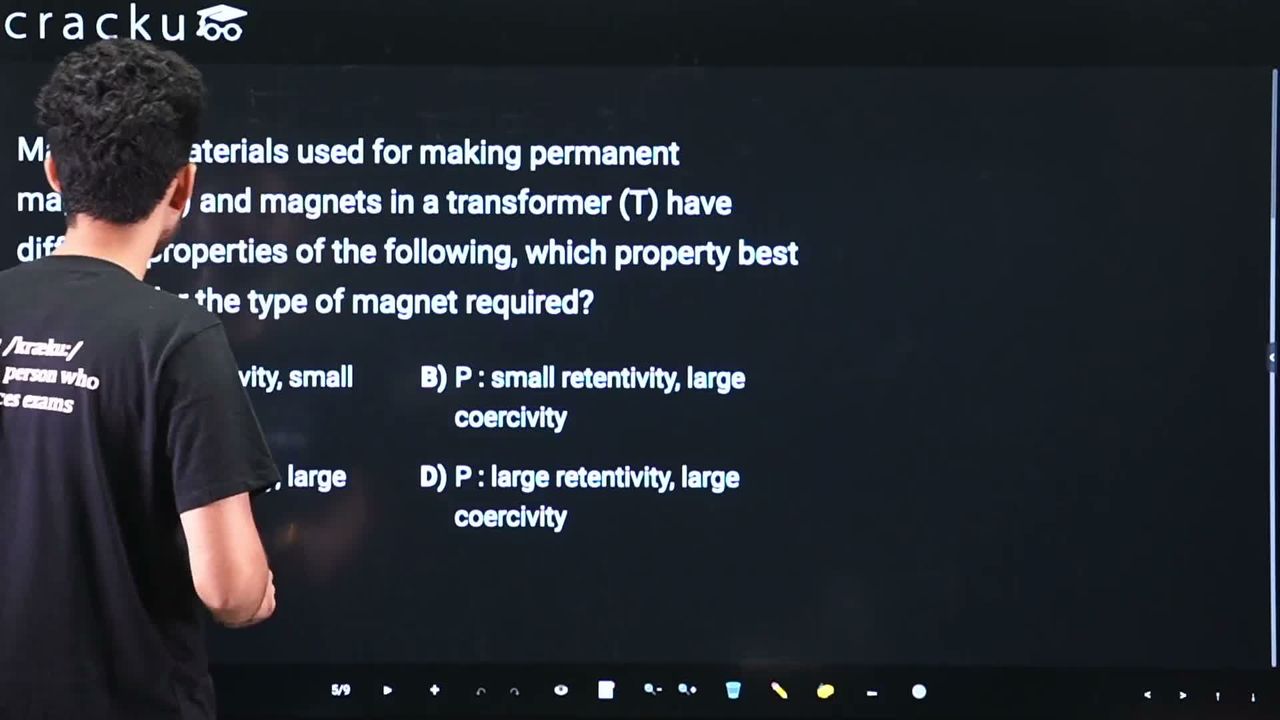
Magnetic materials used for making permanent magnets (P) and magnets in a transformer (T) have different properties of the following, which property best matches for the type of magnet required?
First, let us recall what the two keywords in the options mean.
Retentivity (also called remanence) is the residual value of magnetic induction $$B$$ left in the material when the magnetising field $$H$$ is reduced to zero. In simpler words, a material with large retentivity can hold on to its magnetism for a long time after the external field is removed.
Coercivity is the reverse magnetic field that must be applied to bring that residual induction back to zero. Thus a material with large coercivity needs a strong opposite field to demagnetise it; in other words, it strongly resists any attempt to lose its magnetisation.
Now we analyse the requirements for the two devices mentioned in the question.
For a permanent magnet, we want the magnet to remain magnetised under all ordinary circumstances. Therefore we require
$$\text{Retentivity : large}$$
so that a large residual magnetism is present, and
$$\text{Coercivity : large}$$
so that stray fields, heating, or mechanical shocks cannot easily demagnetise it.
For a transformer core, on the other hand, the magnetic field inside the core is made to reverse direction many times every second (50 Hz or 60 Hz). We need a material whose magnetisation follows the external field easily; otherwise energy will be wasted as heat. Hence, for a transformer we actually desire small coercivity and small retentivity, giving a narrow hysteresis loop and low hysteresis loss.
Scanning the given options, we see that Option D states
$$P : \text{large retentivity, large coercivity}$$
which is exactly the pair of properties we have just concluded to be essential for a permanent magnet. None of the other options simultaneously satisfies both conditions for the permanent magnet, and the statements given for the transformer in the other options are also not the ideal combination.
Hence, the correct answer is Option D.
Was this solution helpful?
Click on the Email ☝️ to Watch the Video Solution
Create a FREE account and get:
_1.webp)

Educational materials for JEE preparation

Ask our AI anything

AI can make mistakes. Please verify important information.
AI can make mistakes. Please verify important information.
