
Join Our JEE Preparation Group
Prep with like-minded aspirants; Get access to free daily tests and study material.
Sign in
Please select an account to continue using cracku.in
↓ →
Join Our JEE Preparation Group
Prep with like-minded aspirants; Get access to free daily tests and study material.
A charged particle (mass m and charge q) moves along X axis with velocity $$V_0$$. When it passes through the origin it enters a region having uniform electric field $$\vec{E} = -E\hat{j}$$ which extends upto $$x = d$$. Equation of path of electron in the region $$x > d$$ is:
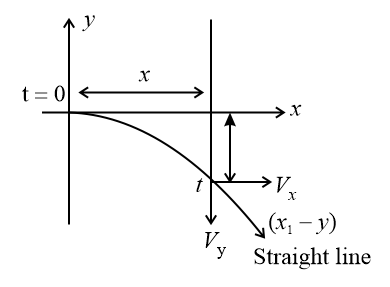
For the region $$0 \le x \le d$$:
$$\text{Time taken to exit the field: } t_1 = \frac{d}{V_0}$$
$$\text{Acceleration along the y-axis: } a_y = -\frac{qE}{m}$$
For the position and velocity components at the boundary $$x = d$$:
$$y_1 = \frac{1}{2}a_y t_1^2 = -\frac{qEd^2}{2mV_0^2}$$
$$V_x = V_0, \quad V_y = a_y t_1 = -\frac{qEd}{mV_0}$$
For the straight-line trajectory in the region $$x > d$$:
$$\text{Slope of the path: } M = \frac{V_y}{V_x} = -\frac{qEd}{mV_0^2}$$
$$\text{Equation of the line passing through } (d, y_1):$$ $$y - y_1 = M(x - d)$$
$$y - \left(-\frac{qEd^2}{2mV_0^2}\right) = -\frac{qEd}{mV_0^2}(x - d)$$ $$\implies$$ $$y = -\frac{qEd^2}{2mV_0^2} - \frac{qEd}{mV_0^2}x + \frac{qEd^2}{mV_0^2}$$
$$y = \frac{qEd}{mV_0^2}\left(\frac{d}{2} - x\right)$$
Was this solution helpful?
Create a FREE account and get:
_1.webp)

Educational materials for JEE preparation

Ask our AI anything

AI can make mistakes. Please verify important information.
AI can make mistakes. Please verify important information.
