
Join Our JEE Preparation Group
Prep with like-minded aspirants; Get access to free daily tests and study material.
Sign in
Please select an account to continue using cracku.in
↓ →
Join Our JEE Preparation Group
Prep with like-minded aspirants; Get access to free daily tests and study material.
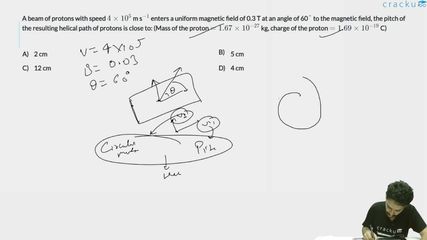
A beam of protons with speed $$4 \times 10^5$$ m s$$^{-1}$$ enters a uniform magnetic field of 0.3 T at an angle of 60$$°$$ to the magnetic field, the pitch of the resulting helical path of protons is close to: (Mass of the proton $$= 1.67 \times 10^{-27}$$ kg, charge of the proton $$= 1.69 \times 10^{-19}$$ C)
We have a stream of protons that enter a uniform magnetic field with speed $$v = 4 \times 10^{5}\,\text{m s}^{-1}$$ making an angle $$\theta = 60^{\circ}$$ with the field. Because the velocity has a component parallel to the field and another component perpendicular to it, each proton follows a helical path. The physical quantity we are asked to find is the pitch of that helix, i.e. the distance travelled parallel to the magnetic field in one complete revolution about the field lines.
First we resolve the velocity into two perpendicular components. Using $$v_{\parallel}=v\cos\theta$$ for the component parallel to the field and $$v_{\perp}=v\sin\theta$$ for the component perpendicular to the field, we write
$$v_{\parallel}=v\cos 60^{\circ}=4\times10^{5}\times\frac12=2\times10^{5}\;\text{m s}^{-1}.$$
The perpendicular component is not directly required for the pitch, but it is this component that causes the circular motion. The circular motion has an angular frequency $$\omega$$ determined by the magnetic force. For a charge $$q$$ moving in a uniform magnetic field $$B$$, the formula for the angular frequency is stated as
$$\omega=\frac{qB}{m},$$
where $$m$$ is the mass of the particle. Substituting the given values $$q=1.69\times10^{-19}\;\text{C},\; B=0.3\;\text{T},\; m=1.67\times10^{-27}\;\text{kg},$$ we obtain
$$\omega=\frac{1.69\times10^{-19}\times0.3}{1.67\times10^{-27}}.$$
Multiplying in the numerator gives
$$1.69\times0.3=0.507,$$
so
$$\omega=\frac{0.507\times10^{-19}}{1.67\times10^{-27}} =\frac{5.07\times10^{-20}}{1.67\times10^{-27}} =3.03\times10^{7}\;\text{s}^{-1}\;(\text{approximately}).$$
The time period $$T$$ of one revolution is the reciprocal of the frequency, and for angular frequency we use
$$T=\frac{2\pi}{\omega}.$$
Substituting $$\omega=3.03\times10^{7}\;\text{s}^{-1}$$ gives
$$T=\frac{2\pi}{3.03\times10^{7}} =\frac{6.283}{3.03}\times10^{-7} =2.07\times10^{-7}\;\text{s}.$$
Now the pitch $$p$$ is the distance travelled along the magnetic field in one time period:
$$p=v_{\parallel}\,T.$$
Using $$v_{\parallel}=2\times10^{5}\;\text{m s}^{-1}$$ and $$T=2.07\times10^{-7}\;\text{s},$$ we have
$$p=2\times10^{5}\times2.07\times10^{-7} =4.14\times10^{-2}\;\text{m}.$$
To express this in centimetres, we multiply by 100:
$$p=4.14\times10^{-2}\times100=4.14\;\text{cm}.$$
The closest value among the options is 4 cm.
Hence, the correct answer is Option D.
Click on the Email ☝️ to Watch the Video Solution
Create a FREE account and get:
_1.webp)

Educational materials for JEE preparation

Ask our AI anything

AI can make mistakes. Please verify important information.
AI can make mistakes. Please verify important information.


