
Join Our JEE Preparation Group
Prep with like-minded aspirants; Get access to free daily tests and study material.
Sign in
Please select an account to continue using cracku.in
↓ →
Join Our JEE Preparation Group
Prep with like-minded aspirants; Get access to free daily tests and study material.
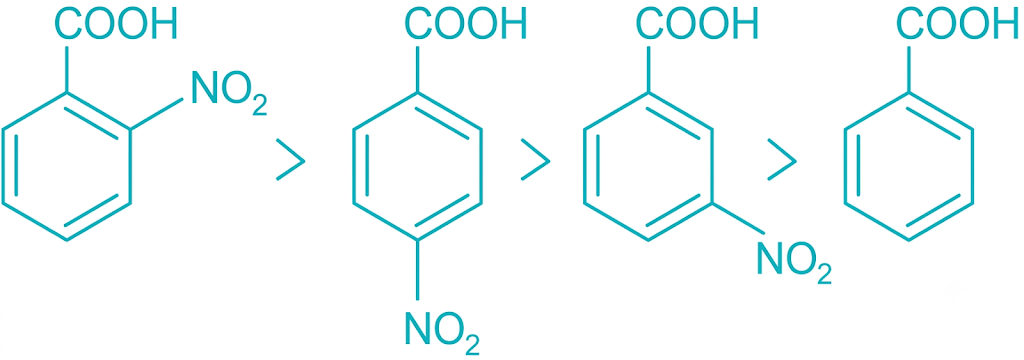
Among substituted benzoic acids, ortho-substituted benzoic acids are generally significantly more acidic than their meta and para isomers, as well as benzoic acid itself, regardless of whether the substituent is electron-withdrawing or electron-donating. This phenomenon is known as the ortho effect.
For the remaining isomers, we evaluate the standard inductive ($$-I$$) and resonance ($$-R$$) electronic effects of the electron-withdrawing nitro group:
$$p\text{-Nitrobenzoic acid}$$ (C):
At the para position, the $$\text{-NO}_2$$ group withdraws electron density via both its strong resonance effect ($$-R$$) and its inductive effect ($$-I$$). This substantial withdrawal strongly stabilizes the carboxylate anion, making it highly acidic (though less so than the ortho-stabilized isomer).
$$m\text{-Nitrobenzoic acid}$$ (D):
At the meta position, resonance interaction between the substituent and the reaction center is geometrically impossible. Therefore, the $$\text{-NO}_2$$ group can only withdraw electron density through its inductive effect ($$-I$$). Because it lacks the powerful resonance withdrawal, it is less acidic than the para isomer.
Benzoic acid (A):
Benzoic acid carries no electron-withdrawing modifications on its ring to stabilize its conjugate base, making it the least acidic compound in this group.
Combining the ortho effect with the relative strengths of the electronic effects gives the final decreasing acidity sequence:
$$\text{o-Nitrobenzoic acid (B)} > \text{p-Nitrobenzoic acid (C)} > \text{m-Nitrobenzoic acid (D)} > \text{Benzoic acid (A)}$$
Correct Order: B > C > D > A
Was this solution helpful?
Create a FREE account and get:
_1.webp)

Educational materials for JEE preparation

Ask our AI anything

AI can make mistakes. Please verify important information.
AI can make mistakes. Please verify important information.
