
Join Our JEE Preparation Group
Prep with like-minded aspirants; Get access to free daily tests and study material.
Sign in
Please select an account to continue using cracku.in
↓ →
Join Our JEE Preparation Group
Prep with like-minded aspirants; Get access to free daily tests and study material.
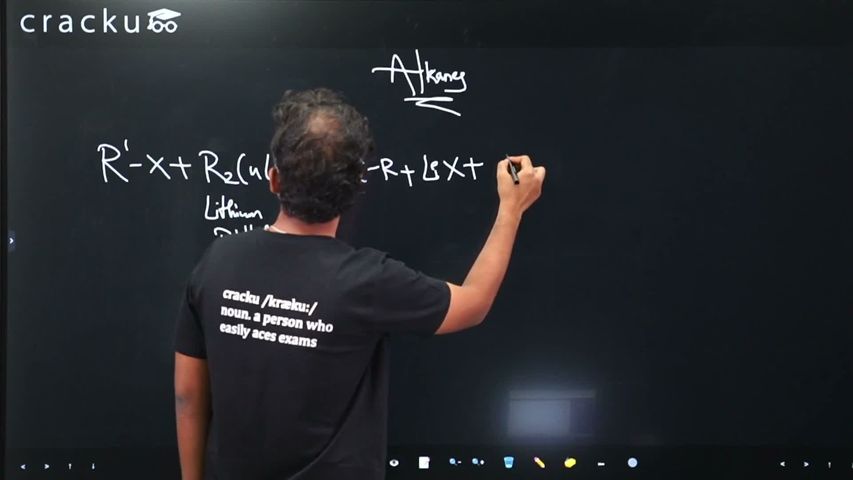
When an alkyl halide $$(R-X)$$ is treated with a lithium dialkylcuprate reagent $$(R_{2}^{\prime }CuLi)$$, a new carbon-carbon $$\sigma $$-bond is formed, yielding a higher alkane $$(R-R')$$.
$$R-X+R_{2}^{\prime }CuLi\longrightarrow R-R^{\prime }+R^{\prime }-Cu+LiX$$
Was this solution helpful?
Click on the Email ☝️ to Watch the Video Solution
Create a FREE account and get:
_1.webp)

Educational materials for JEE preparation

Ask our AI anything

AI can make mistakes. Please verify important information.
AI can make mistakes. Please verify important information.
