Join WhatsApp Icon JEE WhatsApp Group
Question 140

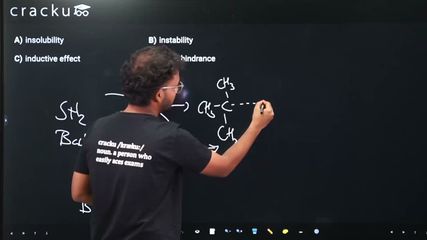
Tertiary alkyl halides are practically inert to substitution by $$S_N 2$$ mechanism because of

Solution

  • Steric hindrance is the correct reason. The $$S_{N}2$$ mechanism requires the nucleophile to attack the electrophilic carbon atom from the exact opposite side of the leaving group (backside attack). In a tertiary alkyl halide, this central carbon is bonded to three bulky alkyl groups. These large groups crowded around the carbon physically block the approaching nucleophile, creating immense steric hindrance and preventing the reaction from occurring.
  • Insolubility is incorrect. Solubility determines how well a compound dissolves in a solvent, but it does not dictate the molecular pathway or kinetic barrier of a substitution mechanism.
  • Instability is incorrect. Tertiary alkyl halides are stable chemical compounds. Furthermore, they readily undergo $$S_{N}1$$ reactions because they form highly stable tertiary carbocations.
  • Inductive effect is incorrect. While the three electron-donating alkyl groups push electron density toward the central carbon via the $$+I$$ effect (which technically reduces its partial positive charge and makes it less electrophilic). 
    Hence, Option D is correct.
  • Get AI Help

    Video Solution

    video

    Create a FREE account and get:

    • Free JEE Mains Previous Papers PDF
    • Take JEE Mains paper tests
    Ask AI