Join WhatsApp Icon JEE WhatsApp Group
Question 14

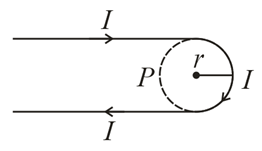
A hairpin like shape as shown in figure is made by bending a long current carrying wire. What is the magnitude of a magnetic field at point $$P$$ which lies on the centre of the semicircle?
We need to determine the maximum force $$F$$ (tension $$T$$) that the boy can exert on the rope so that the piece of wood remains at rest on the floor.

1. Identify the Forces acting on the Boy

Let the tension in the rope held by the boy be $$T$$. The forces acting vertically on the boy (mass $$m = 4\text{ kg}$$) are:

  • The downward gravitational force: $$mg = 4 \times 10 = 40\text{ N}$$
  • The upward normal reaction force from the wood surface: $$R$$
  • The upward pulling force from the rope: $$T$$ (since the rope pulls the boy upwards as he pulls down on it)

For vertical equilibrium of the boy:

$$R + T = mg \implies R = 40 - T \quad \text{--- (Equation 1)}$$

2. Identify the Forces acting on the Piece of Wood

Let's look at the forces acting on the piece of wood (mass $$M = 5\text{ kg}$$):

  • Vertical Forces:
    • Downward gravitational force: $$Mg = 5 \times 10 = 50\text{ N}$$
    • Downward normal pressing force from the boy: $$R$$
    • Upward normal reaction force from the floor: $$N$$

    For vertical equilibrium of the wood:

    $$N = Mg + R$$

    Substitute $$R$$ from Equation 1 into this expression:

    $$N = 50 + (40 - T) = 90 - T \quad \text{--- (Equation 2)}$$

  • Horizontal Forces:
    • Based on the pulley system shown in the diagram on the  page, the tension $$T$$ pulls the piece of wood horizontally to the right.
    • The limiting static frictional force ($$f_s$$) from the floor opposes this motion by acting to the left:

      $$f_s = \mu \cdot N$$

3. Set up the Condition for No Movement

For the wood to stay in its place, the horizontal pulling force ($$T$$) must not exceed the maximum limiting friction ($$f_s$$):

$$T \le \mu \cdot N$$

Substitute the value of coefficient of friction ($$\mu = 0.5$$) and the normal force expression from Equation 2:

$$T = 0.5 \times (90 - T)$$

$$T = 45 - 0.5T$$

$$1.5T = 45$$

$$T = \frac{45}{1.5} = 30\text{ N}$$

Conclusion

The maximum force that the boy can exert on the rope so that the piece of wood does not move is 30 N.

Get AI Help

Create a FREE account and get:

  • Free JEE Mains Previous Papers PDF
  • Take JEE Mains paper tests

Free JEE Topicwise Questions

JEE Atomic StructureJEE Applications of DerivativesJEE Complex NumbersJEE Fluid MechanicsJEE Alcohols, Phenols & EthersJEE Basic Principles of Organic ChemistryJEE Trigonometric FunctionsJEE Three Dimensional GeometryJEE Electromagnetic WavesJEE Redox ReactionsJEE SolutionsJEE Laws of ThermodynamicsJEE Ray OpticsJEE Organic Compounds with HalogensJEE Chemical ThermodynamicsJEE Permutations & CombinationsJEE DeterminantsJEE EMF & Circuit AnalysisJEE Aldehydes & KetonesJEE Atoms & NucleiJEE Dual Nature of Matter & RadiationJEE Electric Charges & FieldsJEE Number SystemJEE Units & MeasurementsJEE Simple Harmonic MotionJEE ElasticityJEE Alternating CurrentsJEE Practical Organic ChemistryJEE Electromagnetic InductionJEE Rotational MotionJEE Hydrocarbons - AlkynesJEE CirclesJEE Kinematics - 1D MotionJEE Purification & CharacterisationJEE Nitrogen-Containing CompoundsJEE Magnetism & Magnetic MaterialsJEE Basic Concepts in ChemistryJEE Laboratory Experiments - XIJEE Periodic Table & PeriodicityJEE Coordination CompoundsJEE Inverse Trigonometric FunctionsJEE Kinetic Theory of GasesJEE Carboxylic AcidsJEE Hydrocarbons - AlkanesJEE d and f-Block ElementsJEE StatisticsJEE LimitsJEE Laws of MotionJEE Electronic DevicesJEE Continuity & DifferentiabilityJEE Sets, Relations & FunctionsJEE Work, Energy & PowerJEE Straight LinesJEE Surface TensionJEE Vector AlgebraJEE ElectrochemistryJEE Kinematics - 2D MotionJEE Chemical KineticsJEE Magnetic Effects of CurrentJEE Binomial TheoremJEE Definite IntegrationJEE ProbabilityJEE Sequences & SeriesJEE Hydrocarbons - AromaticJEE Chemical Bonding & Molecular StructureJEE Hydrocarbons - AlkenesJEE Quadratic EquationsJEE DifferentiationJEE GravitationJEE JEE 2D GeometryJEE p-Block Elements (Groups 13-18)JEE Wave OpticsJEE BiomoleculesJEE Heat TransferJEE Current & ResistanceJEE MatricesJEE Differential EquationsJEE EquilibriumJEE WavesJEE Indefinite IntegrationJEE Electric Potential & CapacitanceJEE Conic Sections
Ask AI


