
Join Our JEE Preparation Group
Prep with like-minded aspirants; Get access to free daily tests and study material.
Sign in
Please select an account to continue using cracku.in
↓ →
Join Our JEE Preparation Group
Prep with like-minded aspirants; Get access to free daily tests and study material.
The four arms of a Wheatstone bridge have resistances as shown in the figure. A galvanometer of 15$$\Omega$$ resistance is connected across BD. Calculate the current through the galvanometer when a potential difference of 10 V is maintained across AC.
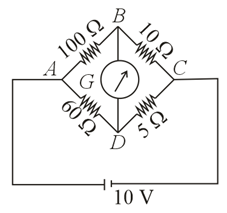
The Wheatstone bridge has four resistances in its arms with a galvanometer of resistance $$G = 15 \, \Omega$$ connected across BD, and a potential difference of 10 V applied across AC. From the given figure, the arm resistances are $$AB = 100 \, \Omega$$, $$BC = 10 \, \Omega$$, $$AD = 60 \, \Omega$$, and $$DC = 5 \, \Omega$$.
We apply Thevenin's theorem across BD. With the galvanometer removed, B and D acquire potentials determined by the two voltage dividers. The potential at B (in the path A-B-C) is $$V_B = \frac{R_{BC}}{R_{AB} + R_{BC}} \times 10 = \frac{10}{100 + 10} \times 10 = \frac{100}{110} = \frac{10}{11}$$ V. The potential at D (in the path A-D-C) is $$V_D = \frac{R_{DC}}{R_{AD} + R_{DC}} \times 10 = \frac{5}{60 + 5} \times 10 = \frac{50}{65} = \frac{10}{13}$$ V.
The Thevenin voltage is $$V_{th} = V_B - V_D = \frac{10}{11} - \frac{10}{13} = \frac{130 - 110}{143} = \frac{20}{143}$$ V.
The Thevenin resistance, obtained by shorting the 10 V source, is the parallel combination of $$R_{AB}$$ and $$R_{BC}$$ in series with the parallel combination of $$R_{AD}$$ and $$R_{DC}$$: $$R_{th} = \frac{100 \times 10}{100 + 10} + \frac{60 \times 5}{60 + 5} = \frac{1000}{110} + \frac{300}{65} = \frac{100}{11} + \frac{60}{13} = \frac{1300 + 660}{143} = \frac{1960}{143}$$ $$\Omega$$.
The galvanometer current is $$I_G = \frac{V_{th}}{R_{th} + G} = \frac{20/143}{1960/143 + 15} = \frac{20/143}{(1960 + 2145)/143} = \frac{20}{4105} = 4.87 \times 10^{-3}$$ A $$= 4.87$$ mA.
Was this solution helpful?
Create a FREE account and get:
_1.webp)

Educational materials for JEE preparation

Ask our AI anything

AI can make mistakes. Please verify important information.
AI can make mistakes. Please verify important information.


