
Join Our JEE Preparation Group
Prep with like-minded aspirants; Get access to free daily tests and study material.
Sign in
Please select an account to continue using cracku.in
↓ →
Join Our JEE Preparation Group
Prep with like-minded aspirants; Get access to free daily tests and study material.
Two cells of emf $$2E$$ and $$E$$ with internal resistance $$r_1$$ and $$r_2$$ respectively are connected in series to an external resistor $$R$$ (see figure). The value of $$R$$, at which the potential difference across the terminals of the first cell becomes zero is:
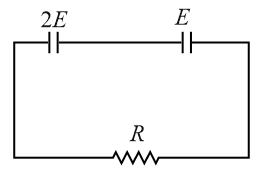
We need to determine the value of the external resistance $$R$$ at which the potential difference across the terminals of the first cell becomes zero.
From the circuit diagram, two cells are connected in series aiding each other (their polarities are aligned in the same direction to drive current together through the external resistor $$R$$):
Using Ohm's law for the complete series loop, the total current flowing through the circuit is equal to the total net electromotive force divided by the total equivalent resistance:
$$I = \frac{\text{Net EMF}}{\text{Total Resistance}} = \frac{2E + E}{R + r_1 + r_2}$$
$$I = \frac{3E}{R + r_1 + r_2}$$
The terminal potential difference ($$V_1$$) across the first cell during discharge is given by the expression:
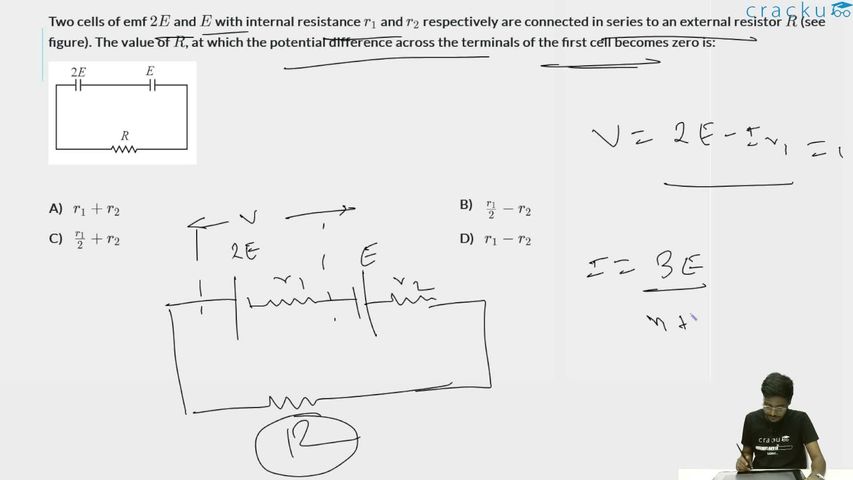
$$V_1 = 2E - I r_1$$
According to the problem statement, this terminal potential difference is equal to zero ($$V_1 = 0$$):
$$2E - I r_1 = 0 \implies 2E = I r_1$$
Substitute our expression for total current ($$I$$) from Step 2 into the condition equation:
$$2E = \left( \frac{3E}{R + r_1 + r_2} \right) r_1$$
Divide both sides of the equation by $$E$$ to eliminate it:
$$2 = \frac{3r_1}{R + r_1 + r_2}$$
Cross-multiply to clear the denominator:
$$2(R + r_1 + r_2) = 3r_1$$
$$2R + 2r_1 + 2r_2 = 3r_1$$
Isolate the term containing $$2R$$ by shifting the internal resistance terms to the right-hand side:
$$2R = 3r_1 - 2r_1 - 2r_2$$
$$2R = r_1 - 2r_2$$
$$R = \frac{r_1}{2} - r_2$$
The value of the external resistor $$R$$ at which the terminal voltage of the first cell drops to zero is $$\frac{r_1}{2} - r_2$$, which corresponds to Option B.
Was this solution helpful?
Click on the Email ☝️ to Watch the Video Solution
Create a FREE account and get:
_1.webp)

Educational materials for JEE preparation

Ask our AI anything

AI can make mistakes. Please verify important information.
AI can make mistakes. Please verify important information.


