
Join Our JEE Preparation Group
Prep with like-minded aspirants; Get access to free daily tests and study material.
Sign in
Please select an account to continue using cracku.in
↓ →
Join Our JEE Preparation Group
Prep with like-minded aspirants; Get access to free daily tests and study material.
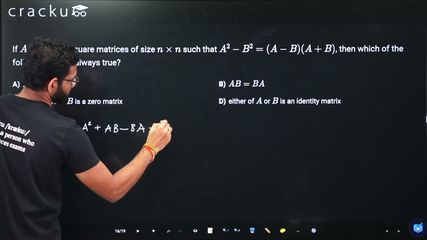
If $$A$$ and $$B$$ are square matrices of size $$n \times n$$ such that $$A^2 - B^2 = (A - B)(A + B)$$, then which of the following will be always true?
The standard algebraic factorisation $$x^2-y^2=(x-y)(x+y)$$ is valid for real numbers because multiplication is commutative. For square matrices, however, the product is not commutative, so the identity need not hold. Here we are told that the matrices $$A$$ and $$B$$ satisfy
$$A^2-B^2=(A-B)(A+B)\qquad -(1)$$
and we must deduce which statement is necessarily true.
Expand the right-hand side of $$(1)$$ keeping the order of the factors intact:
$$\bigl(A-B\bigr)\bigl(A+B\bigr)=A^2+AB-BA-B^2\qquad -(2)$$
Substitute expression $$(2)$$ into $$(1)$$:
$$A^2-B^2=A^2+AB-BA-B^2$$
Cancel the common terms $$A^2$$ and $$-B^2$$ from both sides:
$$0=AB-BA$$
Hence
$$AB=BA$$
Thus the product of the two matrices commutes. No additional restriction on the individual matrices is forced—neither must they be equal, nor must one of them be the zero or identity matrix. (For instance, $$A=\begin{pmatrix}1&0\\0&0\end{pmatrix},\;B=\begin{pmatrix}0&0\\0&2\end{pmatrix}$$ satisfy $$(1)$$ with $$AB=BA$$, yet none of the other options hold.)
Therefore the statement that is always true is:
Option B which is: $$AB=BA$$.
Was this solution helpful?
Click on the Email ☝️ to Watch the Video Solution
Create a FREE account and get:
_1.webp)

Educational materials for JEE preparation

Ask our AI anything

AI can make mistakes. Please verify important information.
AI can make mistakes. Please verify important information.
