
Join Our JEE Preparation Group
Prep with like-minded aspirants; Get access to free daily tests and study material.
Sign in
Please select an account to continue using cracku.in
↓ →
Join Our JEE Preparation Group
Prep with like-minded aspirants; Get access to free daily tests and study material.
An insulated container of gas has two chambers separated by an insulating partition. One of the chambers has volume $$V_1$$ and contains ideal gas at pressure $$P_1$$ and temperature $$T_1$$. The other chamber has volume $$V_2$$ and contains ideal gas at pressure $$P_2$$ and temperature $$T_2$$. If the partition is removed without doing any work on the gas, the final equilibrium temperature of the gas in the container will be
We are dealing with an ideal gas inside an insulated container divided into two chambers. Since the entire container is insulated, there is no heat exchange with the surroundings:
$$\Delta Q = 0$$
Additionally, when the partition is removed, the gas expands freely into the total volume without pushing against any piston or external resistance. Therefore, the net work done by the gas is zero:
$$\Delta W = 0$$
According to the First Law of Thermodynamics ($$\Delta Q = \Delta U + \Delta W$$), the change in total internal energy ($$\Delta U$$) must also be zero:
$$\Delta U = 0 \implies U_{\text{initial}} = U_{\text{final}}$$
This tells us that the total internal energy of the system remains perfectly conserved throughout the mixing process.
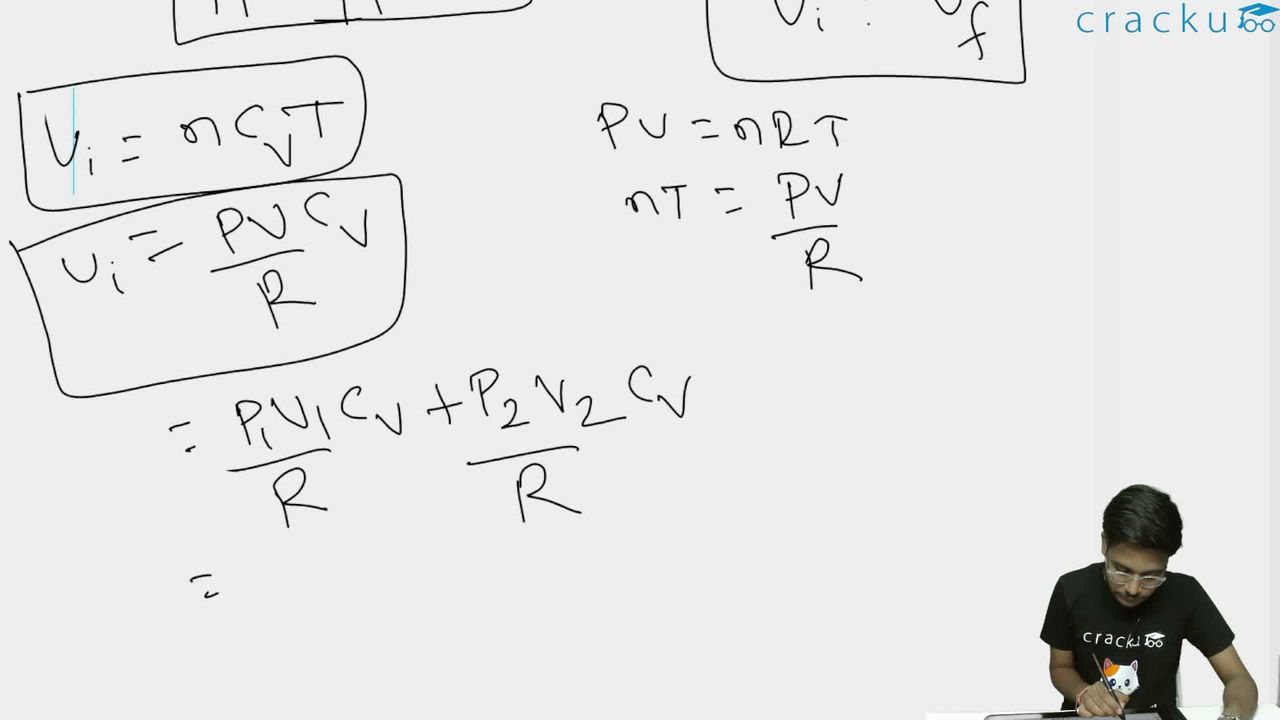
The internal energy ($$U$$) of an ideal gas can be written as a function of the number of moles ($n$), molar heat capacity at constant volume ($C_v$), and temperature ($T$):
$$U = n \cdot C_v \cdot T$$
From the ideal gas equation ($$P \cdot V = n \cdot R \cdot T$$), we can substitute $$n \cdot T = \frac{P \cdot V}{R}$$ into our internal energy expression:
$$U = \left(\frac{C_v}{R}\right) \cdot P \cdot V$$
Let us write out the initial internal energies of both chambers before the partition is removed:
Therefore, the total initial internal energy of the system is:
$$U_{\text{initial}} = U_1 + U_2 = \left(\frac{C_v}{R}\right) \cdot (P_1 \cdot V_1 + P_2 \cdot V_2)$$
Let $$T$$ be the final equilibrium temperature of the mixture, and let $$n_1$$ and $$n_2$$ be the number of moles of gas in each chamber. The total internal energy after equilibrium is reached is given by:
$$U_{\text{final}} = (n_1 + n_2) \cdot C_v \cdot T$$
Using the ideal gas relationship to express the number of moles ($$n = \frac{P \cdot V}{R \cdot T}$$) for each independent chamber:
Substituting these mole expressions into our final internal energy equation:
$$U_{\text{final}} = \left( \frac{P_1 \cdot V_1}{R \cdot T_1} + \frac{P_2 \cdot V_2}{R \cdot T_2} \right) \cdot C_v \cdot T$$
$$U_{\text{final}} = \left(\frac{C_v}{R}\right) \cdot \left( \frac{P_1 \cdot V_1}{T_1} + \frac{P_2 \cdot V_2}{T_2} \right) \cdot T$$
Since internal energy is conserved ($$U_{\text{initial}} = U_{\text{final}}$$):
$$\left(\frac{C_v}{R}\right) \cdot (P_1 \cdot V_1 + P_2 \cdot V_2) = \left(\frac{C_v}{R}\right) \cdot \left( \frac{P_1 \cdot V_1}{T_1} + \frac{P_2 \cdot V_2}{T_2} \right) \cdot T$$
Canceling the constant factor $$\left(\frac{C_v}{R}\right)$$ from both sides:
$$P_1 \cdot V_1 + P_2 \cdot V_2 = \left( \frac{P_1 \cdot V_1 \cdot T_2 + P_2 \cdot V_2 \cdot T_1}{T_1 \cdot T_2} \right) \cdot T$$
Isolating the final equilibrium temperature variable ($$T$$):
$$T = \frac{T_1 \cdot T_2 \cdot (P_1 \cdot V_1 + P_2 \cdot V_2)}{P_1 \cdot V_1 \cdot T_2 + P_2 \cdot V_2 \cdot T_1}$$
Concept Check: Because the container is completely isolated, the molecules cannot dump kinetic energy externally. The thermal equilibrium profile settles into a weighted harmonic relationship that factors in the initial pressure energy configurations alongside individual starting temperatures.
Correct Option Key: Option A ($$\frac{T_1 T_2 (P_1 V_1 + P_2 V_2)}{P_1 V_1 T_2 + P_2 V_2 T_1}$$)
Was this solution helpful?
Click on the Email ☝️ to Watch the Video Solution
Create a FREE account and get:
_1.webp)

Educational materials for JEE preparation

Ask our AI anything

AI can make mistakes. Please verify important information.
AI can make mistakes. Please verify important information.
