
Join Our JEE Preparation Group
Prep with like-minded aspirants; Get access to free daily tests and study material.
Sign in
Please select an account to continue using cracku.in
↓ →
Join Our JEE Preparation Group
Prep with like-minded aspirants; Get access to free daily tests and study material.
An electron gun is placed inside a long solenoid of radius $$R$$ on its axis. The solenoid has $$n$$ turns/length and carries a current $$I$$. The electron gun shoots an electron along the radius of the solenoid with speed $$v$$. If the electron does not hit the surface of the solenoid, maximum possible value of $$v$$ is (all symbols have their standard meaning):
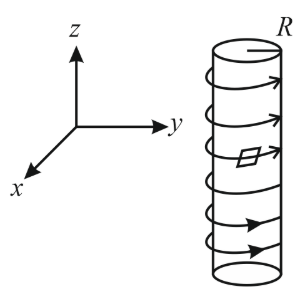
$$B = \mu_0 n I$$
Since the electron is shot radially outwards from the axis, its velocity $$\vec{v}$$ is perpendicular to the axial magnetic field $$\vec{B}$$, causing it to trace a circular path that passes through the center (axis).
To ensure the electron avoids hitting the inner wall of the solenoid of radius $$R$$, the maximum diameter of its circular trajectory cannot exceed the solenoid's radius:
$$2r_{\text{max}} = R \implies r_{\text{max}} = \frac{R}{2}$$
$$\frac{m v_{\text{max}}}{e B} = \frac{R}{2}$$
$$v_{\text{max}} = \frac{e B R}{2m} = \frac{e \mu_0 n I R}{2m}$$
Was this solution helpful?
Create a FREE account and get:
_1.webp)

Educational materials for JEE preparation

Ask our AI anything

AI can make mistakes. Please verify important information.
AI can make mistakes. Please verify important information.
