
Join Our JEE Preparation Group
Prep with like-minded aspirants; Get access to free daily tests and study material.
Sign in
Please select an account to continue using cracku.in
↓ →
Join Our JEE Preparation Group
Prep with like-minded aspirants; Get access to free daily tests and study material.
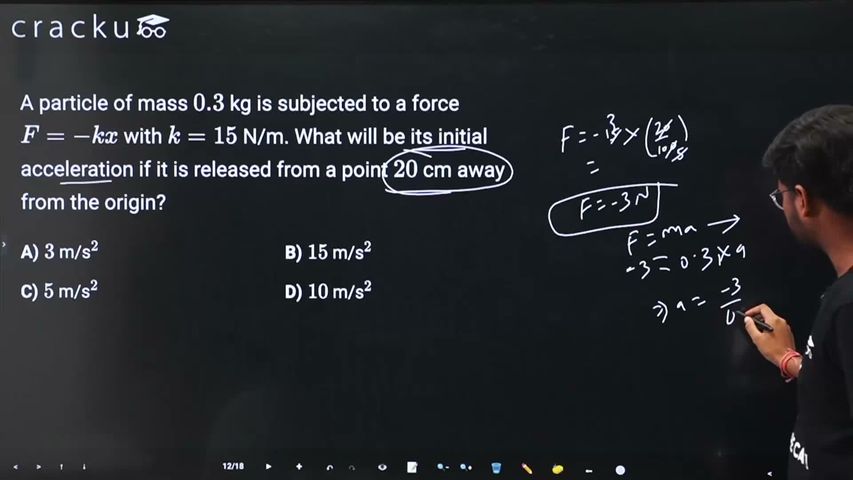
A particle of mass $$0.3$$ kg is subjected to a force $$F = -kx$$ with $$k = 15$$ N/m. What will be its initial acceleration if it is released from a point $$20$$ cm away from the origin?
The particle is subjected to a linear restoring force directed toward the origin, given by the expression:
$$F = -k \cdot x$$
We are given the following values from the problem statement:
First, we convert the displacement from centimeters into SI units (meters):
$$x = \frac{20}{100} = 0.2 \,\, \text{m}$$
Substituting these parameters into the magnitude of the restoring force equation:
$$|F| = 15 \cdot 0.2 = 3.0 \,\, \text{N}$$
According to Newton's Second Law of Motion, the net force acting on a body is equal to the product of its mass ($$m$$) and its acceleration ($$a$$):
$$F = m \cdot a$$
We isolate the acceleration variable ($$a$$) by dividing force by the mass ($$m = 0.3 \,\, \text{kg}$$):
$$a = \frac{|F|}{m}$$
$$a = \frac{3.0}{0.3} = 10 \,\, \text{m/s}^2$$
Concept Check: Because the force is directly proportional to displacement ($$F \propto x$$), the particle experiences its maximum force and maximum acceleration at the exact instant it is released from its point of furthest displacement ($$x = 20 \,\, \text{cm}$$).
Correct Option Key: $$10 \,\, \text{m/s}^2$$
Was this solution helpful?
Click on the Email ☝️ to Watch the Video Solution
Create a FREE account and get:
_1.webp)

Educational materials for JEE preparation

Ask our AI anything

AI can make mistakes. Please verify important information.
AI can make mistakes. Please verify important information.
