
Join Our JEE Preparation Group
Prep with like-minded aspirants; Get access to free daily tests and study material.
Sign in
Please select an account to continue using cracku.in
↓ →
Join Our JEE Preparation Group
Prep with like-minded aspirants; Get access to free daily tests and study material.
$$n$$ moles of an ideal gas undergo a process $$A \to B$$ as shown in the figure. Maximum temperature of the gas during the process is
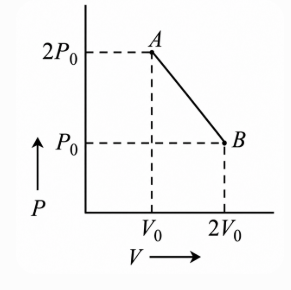
Given points: $$A(V_0, 2P_0)$$, $$B(2V_0, P_0)$$
Using equation of a straight line:
$$P - 2P_0 = \frac{P_0 - 2P_0}{2V_0 - V_0}(V - V_0) = -\frac{P_0}{V_0}(V - V_0)$$
$$P = -\frac{P_0}{V_0}V + 3P_0$$
Using ideal gas law ($$PV = nRT$$):
$$T = \frac{PV}{nR} = \frac{1}{nR}\left(-\frac{P_0}{V_0}V^2 + 3P_0V\right)$$
Differentiating with respect to $$V$$ for maximum temperature:
$$\frac{dT}{dV} = 0 \ ⟹ -\frac{2P_0}{V_0}V + 3P_0 = 0 \ ⟹ V = \frac{3V_0}{2}$$
Substituting $$V$$ to find $$P$$ and $$T_{\text{max}}$$:
$$P = -\frac{P_0}{V_0}\left(\frac{3V_0}{2}\right) + 3P_0 = \frac{3P_0}{2}$$
$$T_{\text{max}} = \frac{P \cdot V}{nR} = \frac{1}{nR}\left(\frac{3P_0}{2}\right)\left(\frac{3V_0}{2}\right) = \frac{9P_0V_0}{4nR}$$
Was this solution helpful?
Create a FREE account and get:
_1.webp)

Educational materials for JEE preparation

Ask our AI anything

AI can make mistakes. Please verify important information.
AI can make mistakes. Please verify important information.
