
Join Our JEE Preparation Group
Prep with like-minded aspirants; Get access to free daily tests and study material.
Sign in
Please select an account to continue using cracku.in
↓ →
Join Our JEE Preparation Group
Prep with like-minded aspirants; Get access to free daily tests and study material.
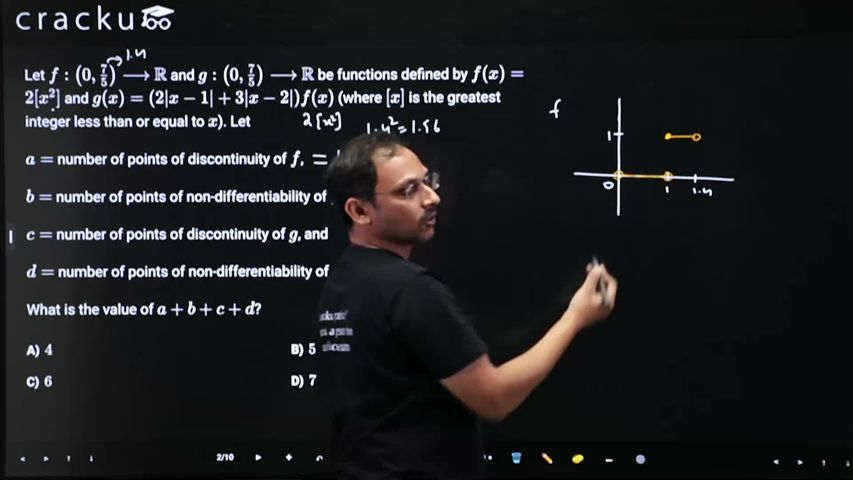
Let $$f:\left(0,\frac{7}{5}\right)\longrightarrow$$ $$\mathbb{R}$$ and $$g:\left(0,\frac{7}{5}\right)\longrightarrow$$ $$\mathbb{R}$$ be functions defined by $$f(x)=2[x^2]$$ and $$g(x)=(2|x-1|+3|x-2|)f(x)$$ (where $$[x]$$ is the greatest integer less than or equal to $$x$$). Let
$$a=$$ number of points of discontinuity of $$f$$,
$$b=$$ number of points of non-differentiability of $$f$$,
$$c=$$ number of points of discontinuity of $$g$$, and
$$d=$$ number of points of non-differentiability of $$g$$.
What is the value of $$a+b+c+d$$?
The domain is given by $$x \in \left(0, \frac{7}{5}\right)$$, which means $$0 < x < 1.4$$.
Let us first analyze the function $$f(x) = 2[x^2]$$.
As $$x$$ ranges from $$0$$ to $$1.4$$, $$x^2$$ ranges from $$0$$ to $$1.96$$.
The greatest integer function $$[x^2]$$ changes its value wherever $$x^2$$ is an integer ($$1$$).This happens at $$x = 1$$.
Breaking down $$f(x)$$ for intervals:
Thus, $$f(x)$$ has a point of discontinuity at $$x = 1$$, making $$a = 1$$. Since $$f(x)$$ is a step function constant on intervals, its derivative is zero everywhere except at $$x = 1$$ where it is non-differentiable, making $$b = 1$$.
Now, let us consider $$g(x) = (2\vert{}x - 1\vert{} + 3\vert{}x - 2\vert{})f(x)$$.
Since we are restricted to the domain $$x \in \left(0, \frac{7}{5}\right)$$, the term $$\vert{}x - 2\vert{}$$ is always equal to $$-(x - 2) = 2 - x$$ because $$x < 1.4 < 2$$.
Therefore, within our domain, $$g(x)$$ simplifies to:
$$g(x) = (2\vert{}x - 1\vert{} + 3(2 - x))f(x) = (2\vert{}x - 1\vert{} + 6 - 3x)f(x)$$
Let's look at the behaviour of $$g(x)$$ over the two sub-intervals:
Let us check continuity and differentiability of $$g(x)$$ at $$x = 1$$:
Since the left-hand limit ($$0$$) does not equal the function value ($$6$$), $$g(x)$$ is discontinuous at $$x = 1$$. Thus, $$c = 1$$.
Since $$g(x)$$ is discontinuous at $$x = 1$$, it is automatically non-differentiable at $$x = 1$$.
Are there any other points of non-differentiability for $$g(x)$$?
Inside the interval $$\left[1, \frac{7}{5}\right)$$, $$g(x) = 8 - 2x$$, which is a straight line and is completely differentiable.
Hence, the only point of non-differentiability for $$g(x)$$ is $$x = 1$$, so $$d = 1$$.
Summing up all the values:
$$a + b + c + d = 1 + 1 + 1 + 1 = 4$$
The correct option is A.
Was this solution helpful?
Click on the Email ☝️ to Watch the Video Solution
Create a FREE account and get:
_1.webp)

Educational materials for JEE preparation

Ask our AI anything

AI can make mistakes. Please verify important information.
AI can make mistakes. Please verify important information.
