
Join Our JEE Preparation Group
Prep with like-minded aspirants; Get access to free daily tests and study material.
Sign in
Please select an account to continue using cracku.in
↓ →
Join Our JEE Preparation Group
Prep with like-minded aspirants; Get access to free daily tests and study material.
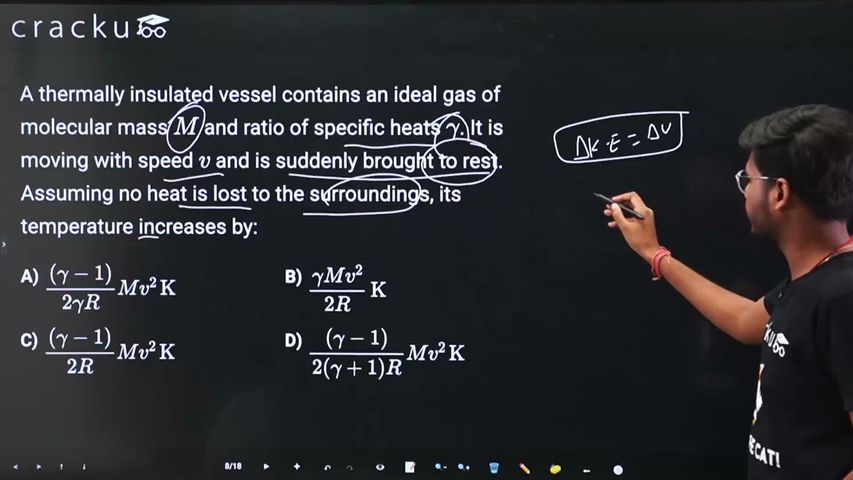
A thermally insulated vessel contains an ideal gas of molecular mass $$M$$ and ratio of specific heats $$\gamma$$. It is moving with speed $$v$$ and is suddenly brought to rest. Assuming no heat is lost to the surroundings, its temperature increases by:
When the moving vessel is suddenly brought to rest, its entire macroscopic bulk kinetic energy ($$K_{\text{bulk}}$$) is stopped. Since the vessel is completely thermally insulated, no heat escapes to the environment ($$\Delta Q = 0$$). According to the First Law of Thermodynamics, this lost mechanical energy is converted entirely into the internal microscopic thermal energy ($$\Delta U$$) of the gas molecules:
$$\Delta U = K_{\text{bulk}}$$
Let $$m$$ be the total mass of the gas contained within the vessel. The bulk kinetic energy lost during the sudden braking phase is given by:
$$K_{\text{bulk}} = \frac{1}{2} \cdot m \cdot v^2$$
The increase in internal energy ($$\Delta U$$) for $$n$$ moles of an ideal gas experiencing a temperature rise of $$\Delta T$$ is defined as:
$$\Delta U = n \cdot C_v \cdot \Delta T$$
Where:
Using the standard thermodynamic relation linking $$C_v$$ to the specific heat ratio ($$\gamma = \frac{C_p}{C_v}$$) and the universal gas constant ($$R$$):
$$C_v = \frac{R}{\gamma - 1}$$
Substituting both $$n$$ and $$C_v$$ expressions back into our internal energy formula yields:
$$\Delta U = \left(\frac{m}{M}\right) \cdot \left(\frac{R}{\gamma - 1}\right) \cdot \Delta T$$
Equating the macroscopic kinetic energy loss to the microscopic internal energy gain:
$$\frac{1}{2} \cdot m \cdot v^2 = \frac{m \cdot R \cdot \Delta T}{M \cdot (\gamma - 1)}$$
We can cancel out the total gas mass variable ($$m$$) from both sides of the balance equation:
$$\frac{1}{2} \cdot v^2 = \frac{R \cdot \Delta T}{M \cdot (\gamma - 1)}$$
Isolating the temperature increment variable ($$\Delta T$$) yields:
$$\Delta T = \frac{(\gamma - 1) \cdot M \cdot v^2}{2R} \,\, \text{K}$$
Concept Check: Because the vessel's organized kinetic energy is randomized into chaotic molecular motions upon stopping, the temperature rise scales directly with the molecular weight ($$M$$). Heavier molecules pack more mechanical momentum per mole for a given speed, resulting in a higher internal energy spike when stopped.
Correct Option Key: Option C ($$\frac{(\gamma - 1)}{2R} \cdot M \cdot v^2 \,\, \text{K}$$)
Was this solution helpful?
Click on the Email ☝️ to Watch the Video Solution
Create a FREE account and get:
_1.webp)

Educational materials for JEE preparation

Ask our AI anything

AI can make mistakes. Please verify important information.
AI can make mistakes. Please verify important information.


